This research report has been funded by Marinade Finance. By providing this disclosure, we aim to ensure that the research reported in this document is conducted with objectivity and transparency. Blockworks Research makes the following disclosures: 1) Research Funding: The research reported in this document has been funded by Marinade Finance. The sponsor may have input on the content of the report, but Blockworks Research maintains editorial control over the final report to retain data accuracy and objectivity. All published reports by Blockworks Research are reviewed by internal independent parties to prevent bias. 2) Researchers submit financial conflict of interest (FCOI) disclosures on a monthly basis that are reviewed by appropriate internal parties. Readers are advised to conduct their own independent research and seek advice of qualified financial advisor before making investment decisions.


Solana’s Staking Economy: From Issuance to Fees
Key Takeaways
- Solana’s validator economy has shifted decisively toward fees. Priority fees now account for roughly 73% of operator revenue, while staker income remains overwhelmingly dependent on declining SOL issuance.
- Lower issuance makes validator selection increasingly consequential. Aggregate staking APY has fallen from 7.13% to 5.43% over the past year, and differences in validator performance, commissions, and fee sharing now represent a more meaningful share of staker returns.
- Marinade’s Stake Auction Marketplace (SAM) provides a functioning bridge between validator fee revenue and staker yield. Validators competitively bid for Marinade’s stake using revenue that can include priority fees, with $27.5M paid through the marketplace since launch.
- SIMD 123 would complement rather than replace SAM. The proposal would standardize how validators share fee revenue onchain, while SAM could remain the competitive pricing layer that determines how much validators share.
- Marinade's staking products have consistently outperformed the network baseline since SAM launched. Marinade Native has delivered an average premium of 58 basis points, positive on 84% of days, demonstrating that auction-driven delegation has produced a persistent and measurable yield advantage.
- Institutional staking is emerging as Marinade’s clearest growth opportunity. Marinade Select combines custody-preserving delegation with a vetted validator set and has grown to 1.22M SOL, as ETFs and treasury companies accumulate a rising share of SOL supply.
Introduction
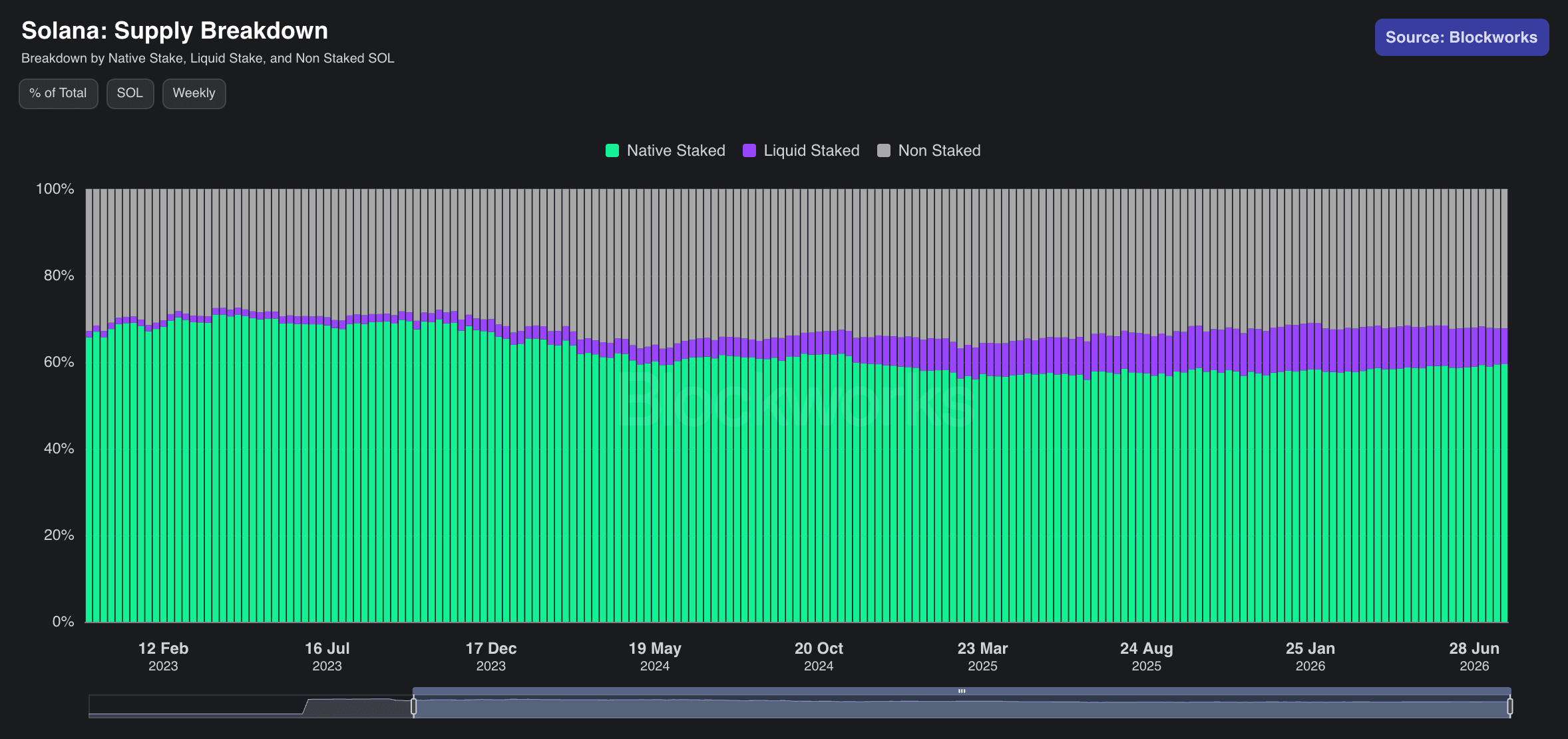
Roughly 68% of SOL is staked, a figure that has barely moved in five years. As a headline statistic it says little. Under the hood, the staking landscape has changed substantially, and the changes coming over the next several months will reshape Solana's validator and staker economics again.
Three forces are converging on Solana's staking economics:
- Competition in block building, with network stake now diversified across competing validator clients;
- A consensus roadmap (Alpenglow, then Multiple Concurrent Proposers) that will rewrite transaction ordering;
- A value-accrual agenda (SIMD 550, SIMD 553, and the long-delayed SIMD 123) that determines how the network's growing fee economy is split between tokenholders, validators, and stakers.
This report covers these three changes and what they mean for validator and staker economics. We then turn to the staking landscape itself: participation, yields, and the delegation market. Finally, we assess Marinade's role within it, from its three staking products to the Stake Auction Marketplace (SAM) that connects validator revenue to staker yield.
Part 1: The Roadmap Repriced Validator Economics
Block builder diversification is now the market structure
For most of 2025, Solana's block building was effectively a monopoly: validators overwhelmingly ran Jito's Agave client, and Jito's block engine sat at the center of transaction processing. That changed in the second half of the year. Jito launched the Block Assembly Marketplace (BAM) in late September 2025, a transaction processing system built around encrypted mempools and application-specific sequencing. In November, Temporal launched Harmonic, a competing block builder that aggregates candidate blocks from multiple builders and lets validators select among them.
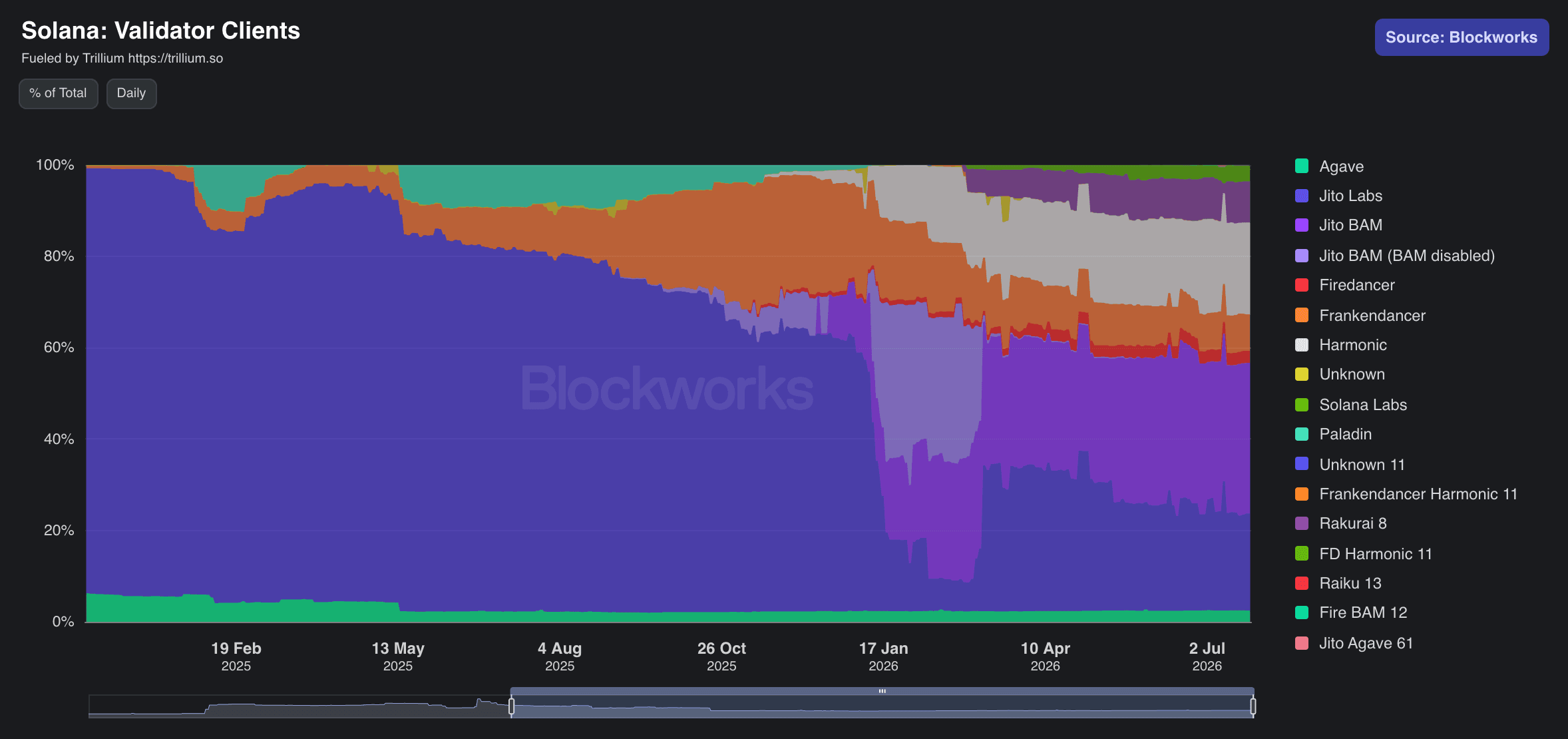
From January to July 7, 2026, BAM grew from 12% to 32% of network stake, while Harmonic clients reached roughly 23%. Legacy Agave-Jito, which held 58% of stake in January, has fallen to 21%. The most notable new entrant is Rakurai, which went from effectively zero at the start of the year to 9% of stake today. The builder landscape keeps diversifying. In under a year, block production went from a single dominant player to a competitive market in which more than half of all stake sits on infrastructure that did not exist eighteen months ago.
The protocol roadmap will reshape this landscape again. Alpenglow, targeted for production in August 2026, replaces Tower BFT and Proof of History and paves the way for Multiple Concurrent Proposers (MCP). MCP would move transaction ordering guarantees into the protocol itself, ordering by priority fee per compute unit and bounding the leader discretion that today's builders compete on.
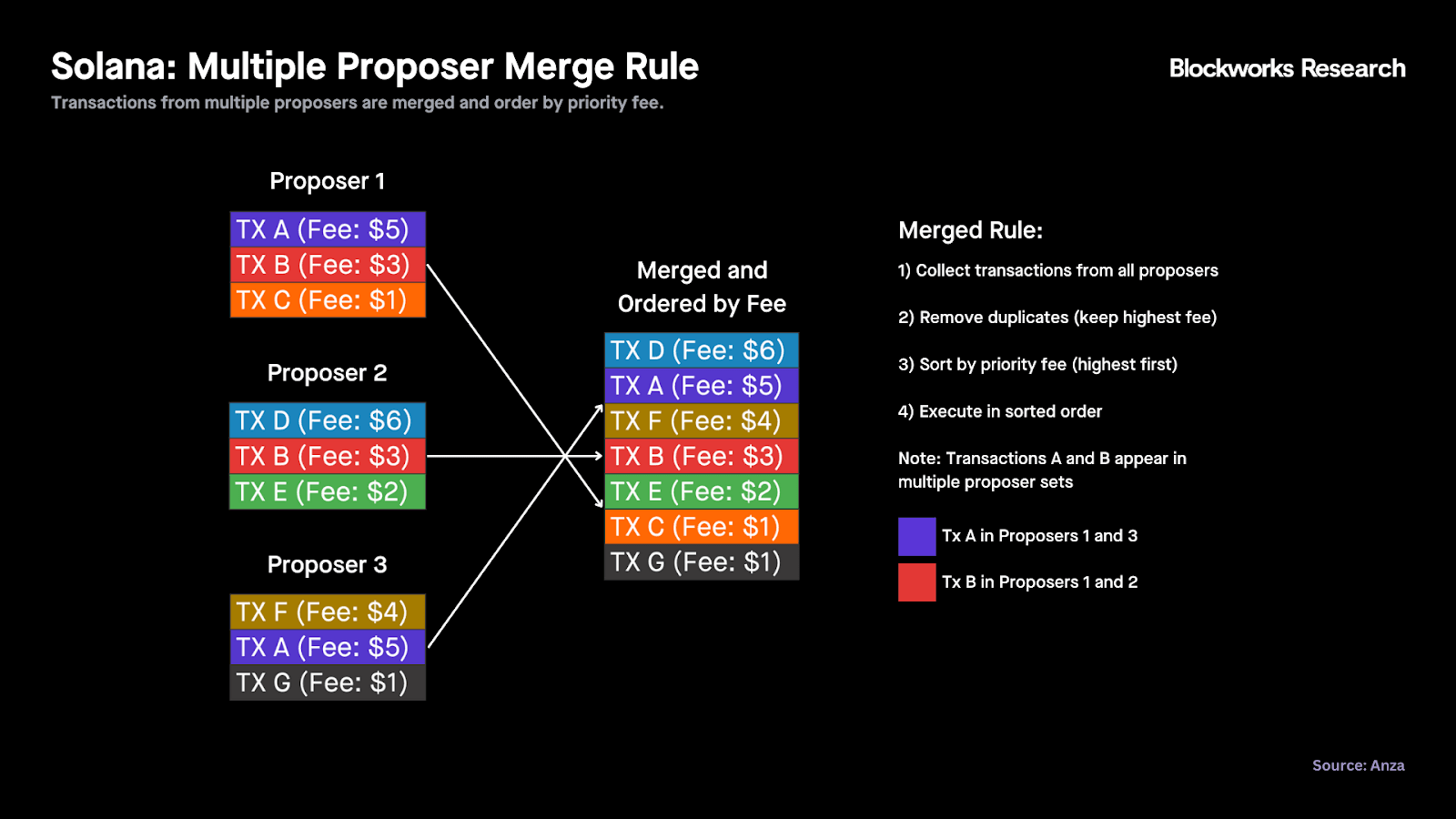
MCP standardizes block construction, but it does not change validator economics at the protocol level. Validators still receive priority fees, and SOL’s issuance schedule remains unchanged. As issuance declines over time, priority fee revenue will therefore account for a larger share of validator income.
Validator revenue has already entered the fee era
The revenue data shows how far this shift has gone. On a trailing 30-day basis, priority fees account for roughly 73% of validator operator revenue network-wide. Commissions on stakers' issuance rewards account for 25%, and commissions on MEV tips for the remaining 2%, out of roughly 6,500 SOL ($490k) per day in total operator revenue. When our data series began in August 2023, the mix was nearly the reverse: issuance commissions were 80% of operator revenue and fees just 20%. The mix inverted in under three years.
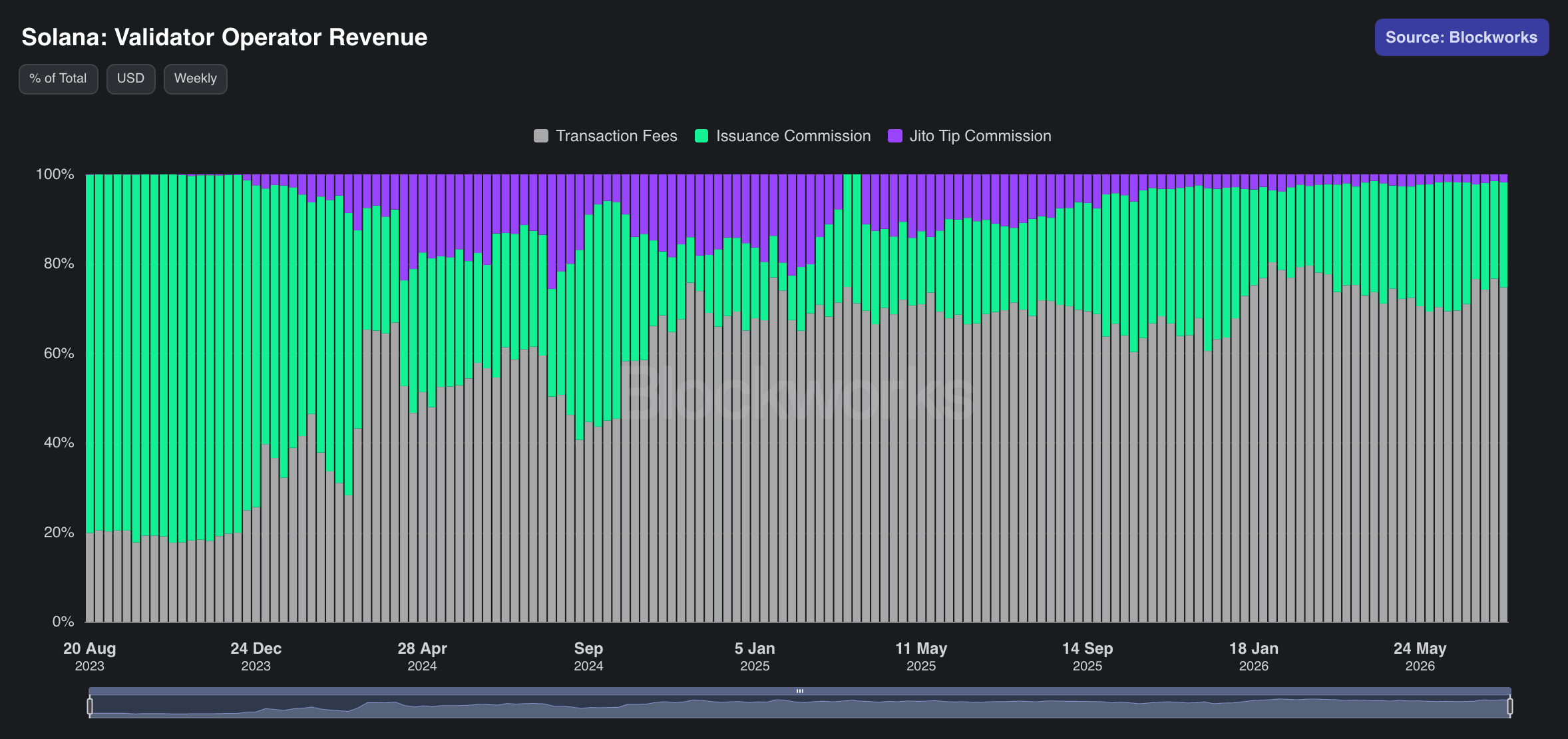
Two structural factors drove this change. First, SIMD 96, activated in February 2025, redirected 100% of priority fees to block producers. This collapsed the burn that previously returned half of priority fees to tokenholders: daily burn fell from over 10,000 SOL during peak Q4 2024 activity to roughly 700 SOL today. Second, Solana follows a fixed emission schedule with 15% annual disinflation, so issuance revenue falls over time by design and fees are expected to carry more of validator and staker economics.
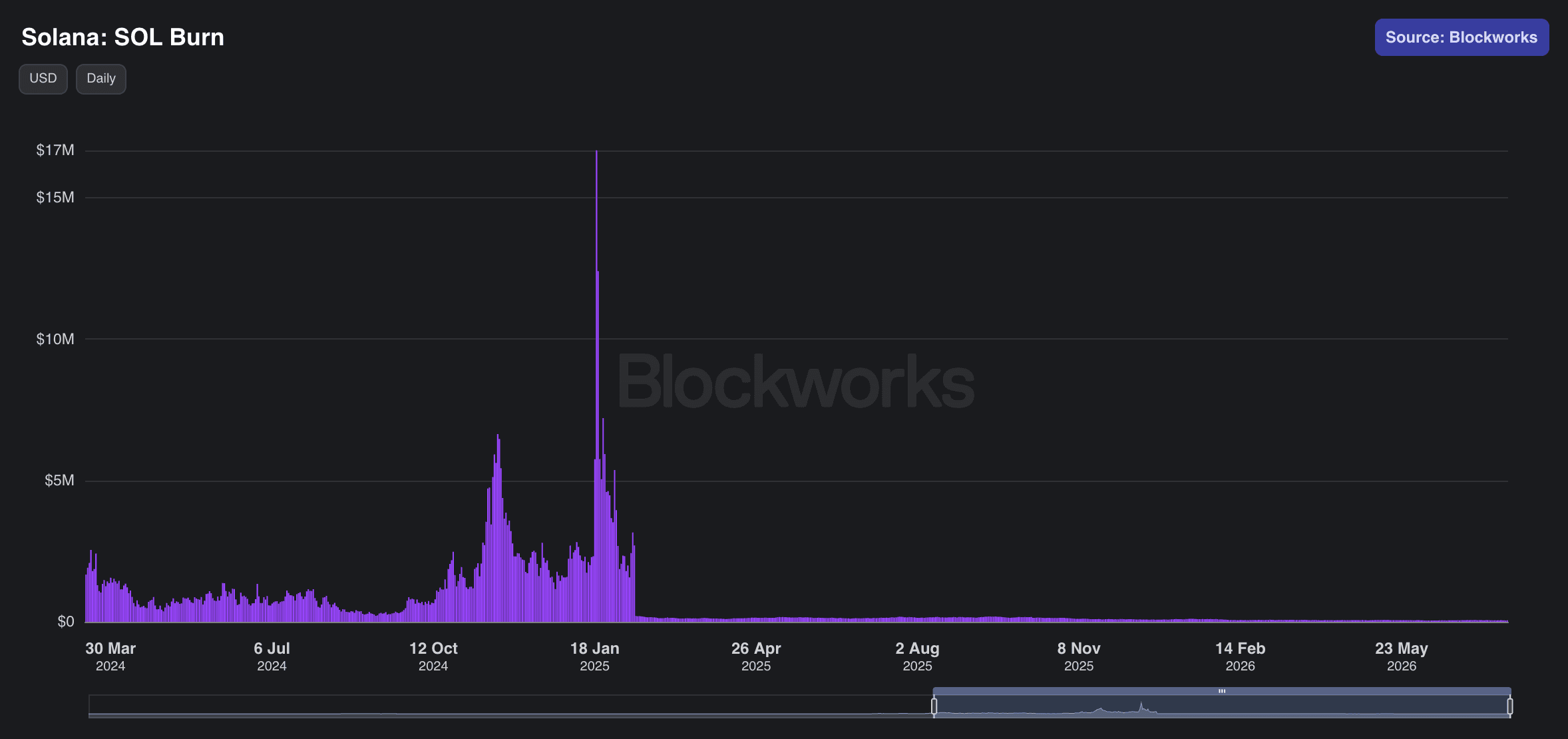
SOL Tokenholder Value Accrual
Today, none of the priority fee revenue reaches stakers in-protocol. On a trailing 30-day basis, stakers earn roughly $4.56M per day from issuance and $83K per day from Jito tip distributions. In other words, issuance is 98% of tracked staker revenue. The tokenholder share of network REV tells the same story: it has fallen from 68% in January 2025 to 27% today.
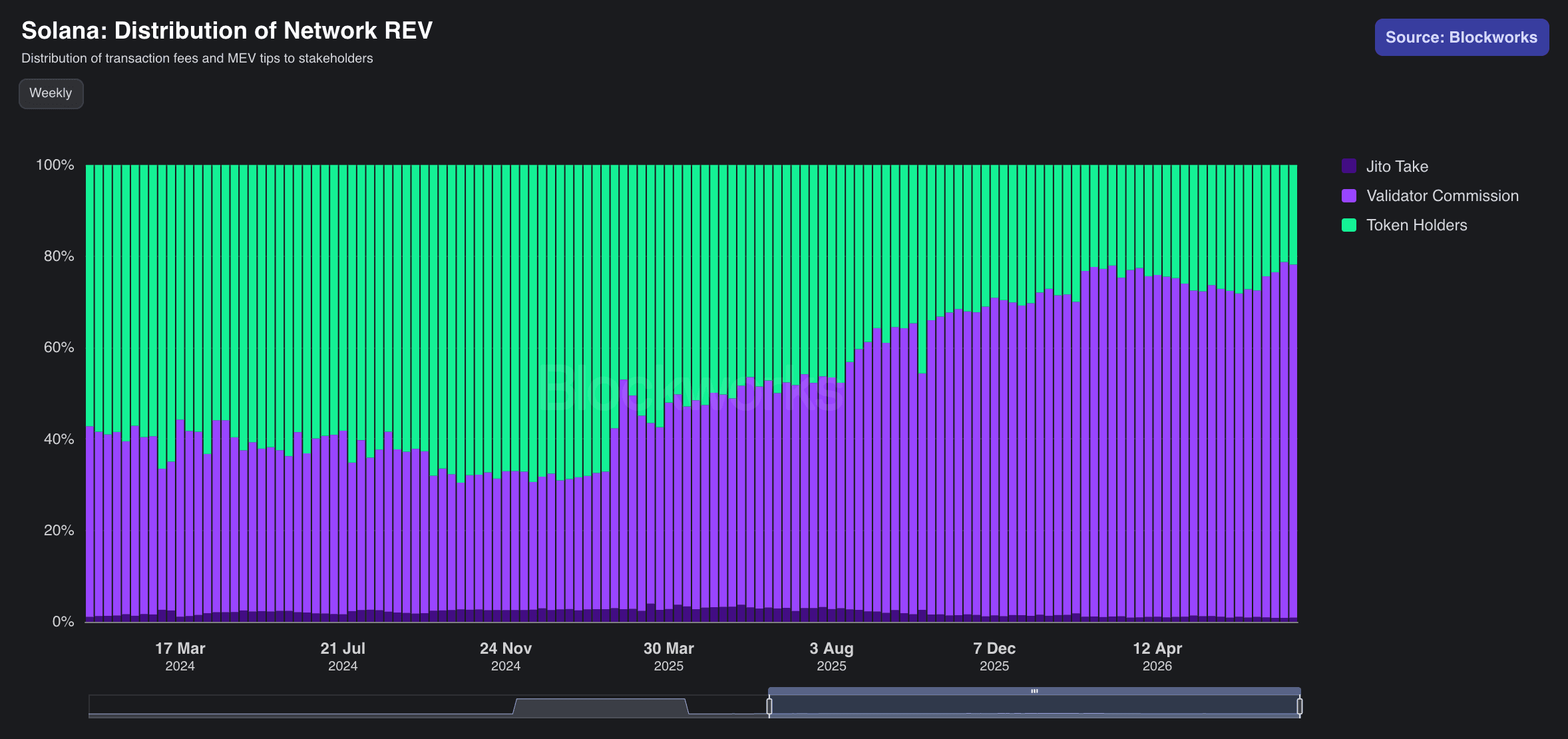
The true staker share is somewhat higher, because large validators like Jupiter and Helius already share priority fees through third-party solutions. But those flows are validator-specific and hard to track. The broader problem remains: there is no in-protocol way to share priority fees with stakers the way validators can share issuance.
Notably, Marinade provides a working solution today. Its Stake Auction Marketplace (SAM), covered in detail in Part 3, runs a per-epoch auction where validators bid for Marinade's stake. Winning validators pay for that stake out of their own revenue, including priority fees. A bid takes one of two forms: a fixed amount per epoch, settled from a collateral bond, or a percentage of the validator's inflation, MEV, or block rewards. Stakers receive this money as auction proceeds rather than a fee split, and because everything settles through one marketplace, the flows are trackable, unlike validator-specific arrangements.
SAM is a market workaround, though, not a change at the network level. Three live proposals would change SOL’s underlying value accrual framework, each addressing a different side of it, and it is worth being precise about which does what.
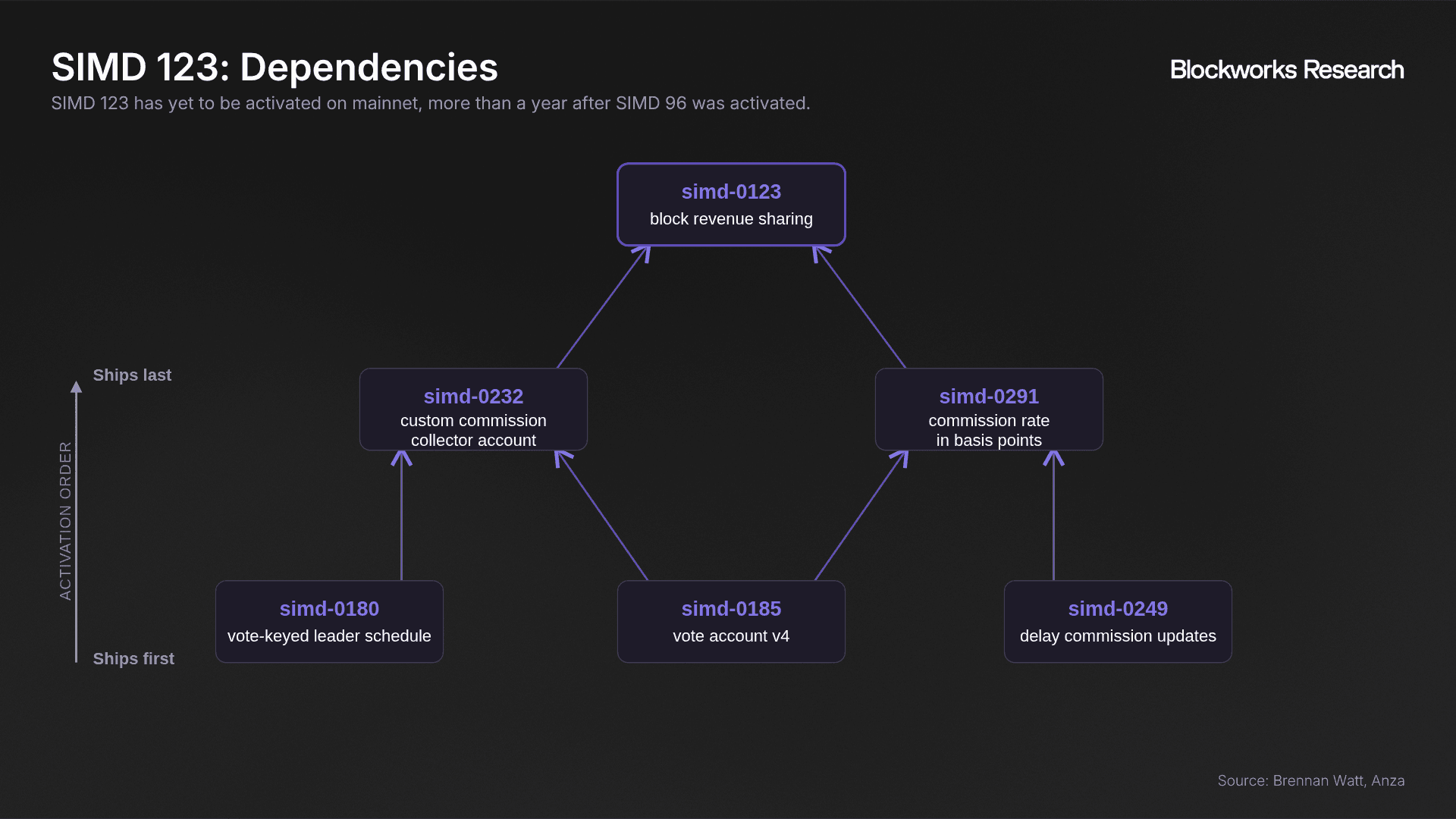
SIMD 123 would create the in-protocol mechanism for validators to share priority fees and block rewards with stakers. It still has dependencies before activation, including SIMD 232 and SIMD 291, both of which come with their own prerequisite work.
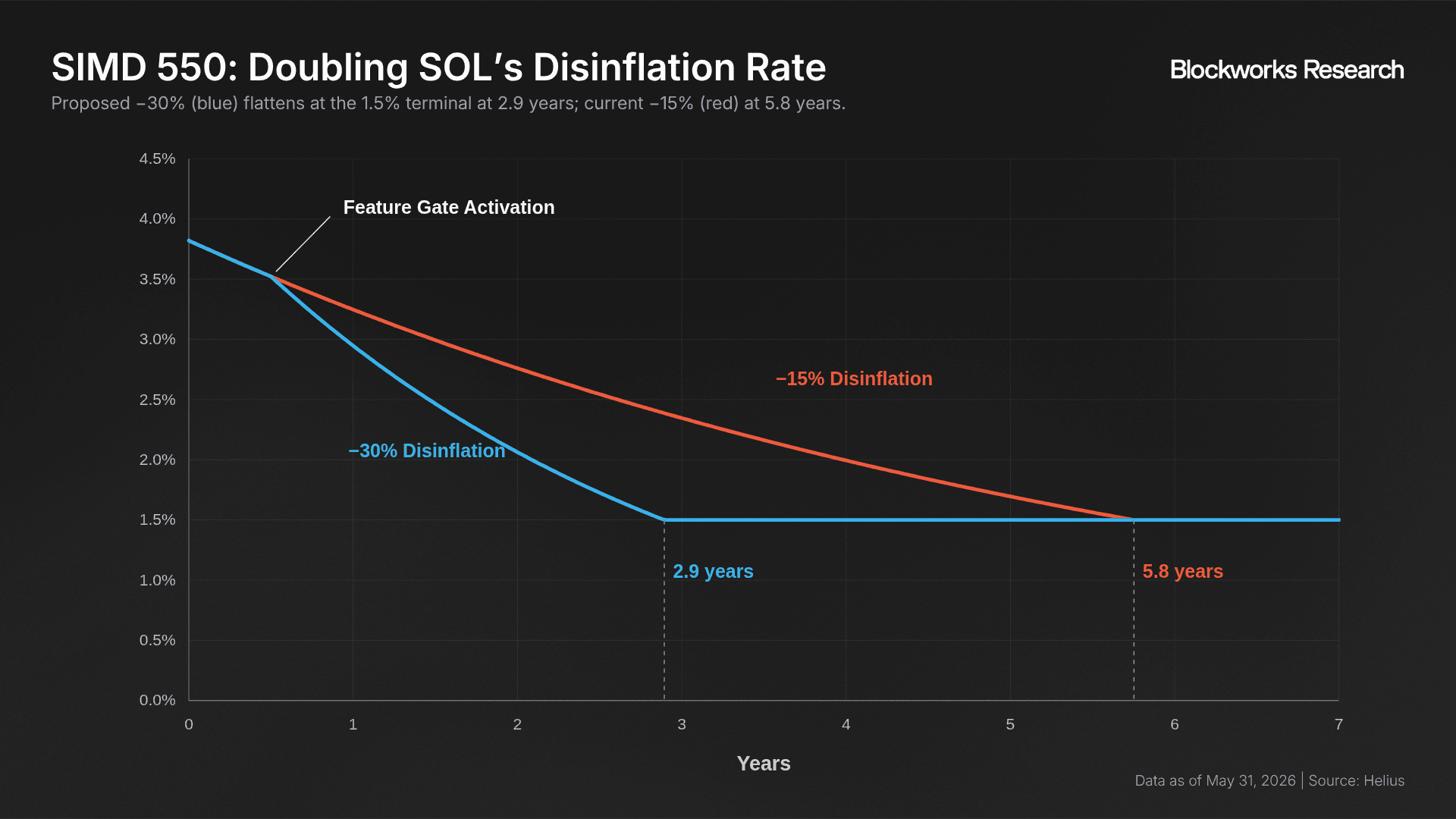
SIMD 550, from Helius, would double Solana's disinflation rate from 15% to 30%, holding the 1.5% terminal rate and reaching it in roughly 2.9 years instead of 5.8. We believe SIMD 550 reduces unnecessary issuance and strengthens SOL economics. But its first-order effect on stakers is lower nominal yield, since it compresses their largest revenue stream.
SIMD 553, from Temporal, would introduce a fully burned, resource-based fee on requested cost units. The draft estimates 7,500 to 9,000 SOL per day of burn, offsetting roughly 12.5% to 15.0% of daily issuance. The key feature is that the burn scales with network usage, fee parameters, and future capacity growth.
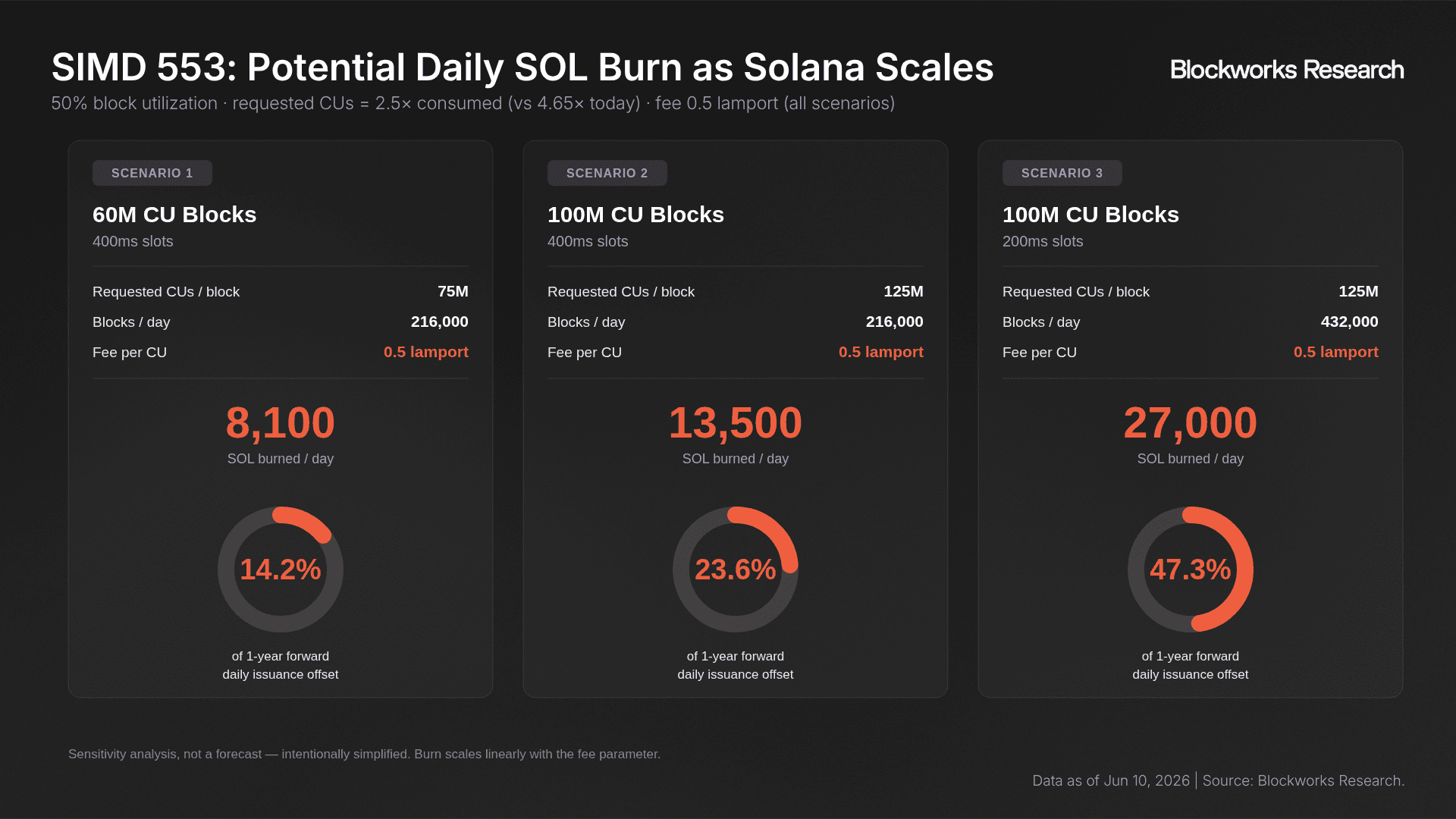
That said, the effects of SIMD 553 are unlikely to be linear. A per-CU burn would push applications to optimize their compute usage, which they have little reason to do today, lowering requested CUs per transaction over time. A higher per-transaction cost would also deter some activity in theory, but much of the compute demand today comes from price insensitive users, for example memecoin traders on platforms like Pumpfun, so realized burn may hold up better than a demand-elasticity argument would suggest.
After Alpenglow, Solana will keep pushing for higher bandwidth and lower latency, which means larger blocks and, eventually, shorter slot times. That is why the scenarios above also consider 100M CU blocks and 200ms slots.
Put together, the roadmap is coherent for tokenholders: less issuance and more activity-linked burn. For stakers it is deliberately austere. If SIMD 550 passes, issuance yield compresses on an accelerated schedule. If SIMD 553 passes, the fee economy's growth accrues to all tokenholders via supply reduction, not just stakers. The only mechanism that grows staker income is validator revenue sharing, and until SIMD 123 clears its dependency chain, that mechanism exists only out of protocol: in validator-specific LST arrangements, and in delegation marketplaces that price it competitively. That is the context for the staking landscape below.
Part 2: The Staking Landscape
Participation is stable; economics are compressing
As mentioned, SOL's staking rate has held near 68% for years, with liquid staking at 13.2% of total stake, up from about 10% at the start of 2025. Yields are another matter. Aggregate staking APY has fallen from 7.13% to 5.43% over the past year as inflation declined from 4.43% to 3.75% on the existing disinflation schedule. Real (inflation-adjusted) staking yield stands at roughly 1.7%. So far, participation looks rate inelastic: a ~170 bps drop in nominal yield has not moved the staking rate. SIMD 550 would steepen that decline, testing whether that inelasticity holds at lower yields.
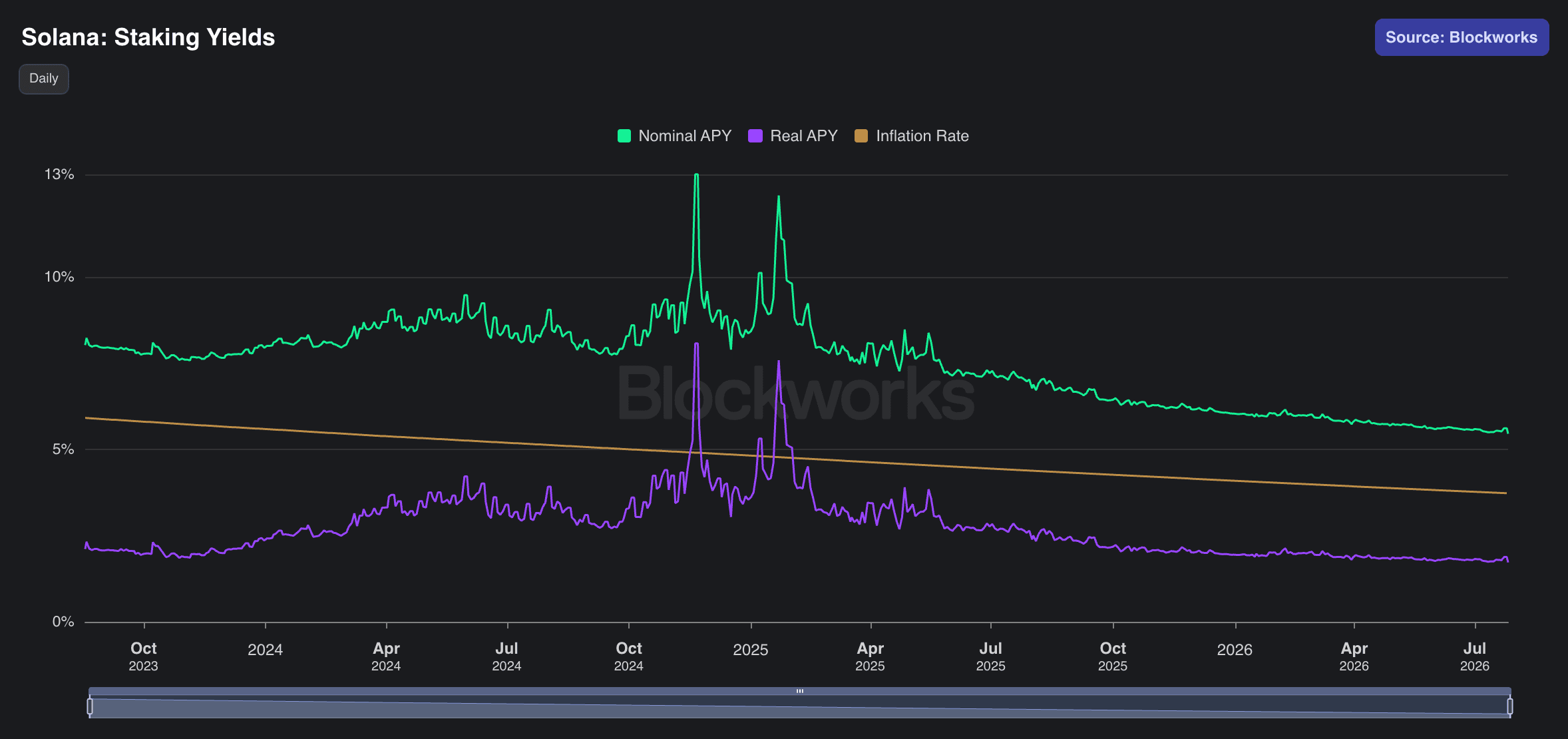
Lower staking yields make delegation more consequential. When staking paid more than 7% and validator economics were broadly similar, the choice of validator mattered little. At a 5.4% headline yield and 1.7% real yield, differences in validator performance and commission account for an increasingly meaningful share of returns. SIMD 550 would sharpen that further.
The delegation market
That dispersion is wider than it looks. Across validators with more than 100K SOL delegated, observable net staking APY spans roughly 60 bps from the 10th to the 90th percentile (5.29% to 5.88%). But observable APY excludes exactly the revenue Part 1 showed is now dominant. The figure below measures what is missing at the client level: average rewards per block range from 0.020 SOL for vanilla Agave to 0.044 SOL for Frankendancer-Harmonic validators, a 2.2x gap, and the gap is almost entirely priority fees, the one component with no in-protocol path to stakers.
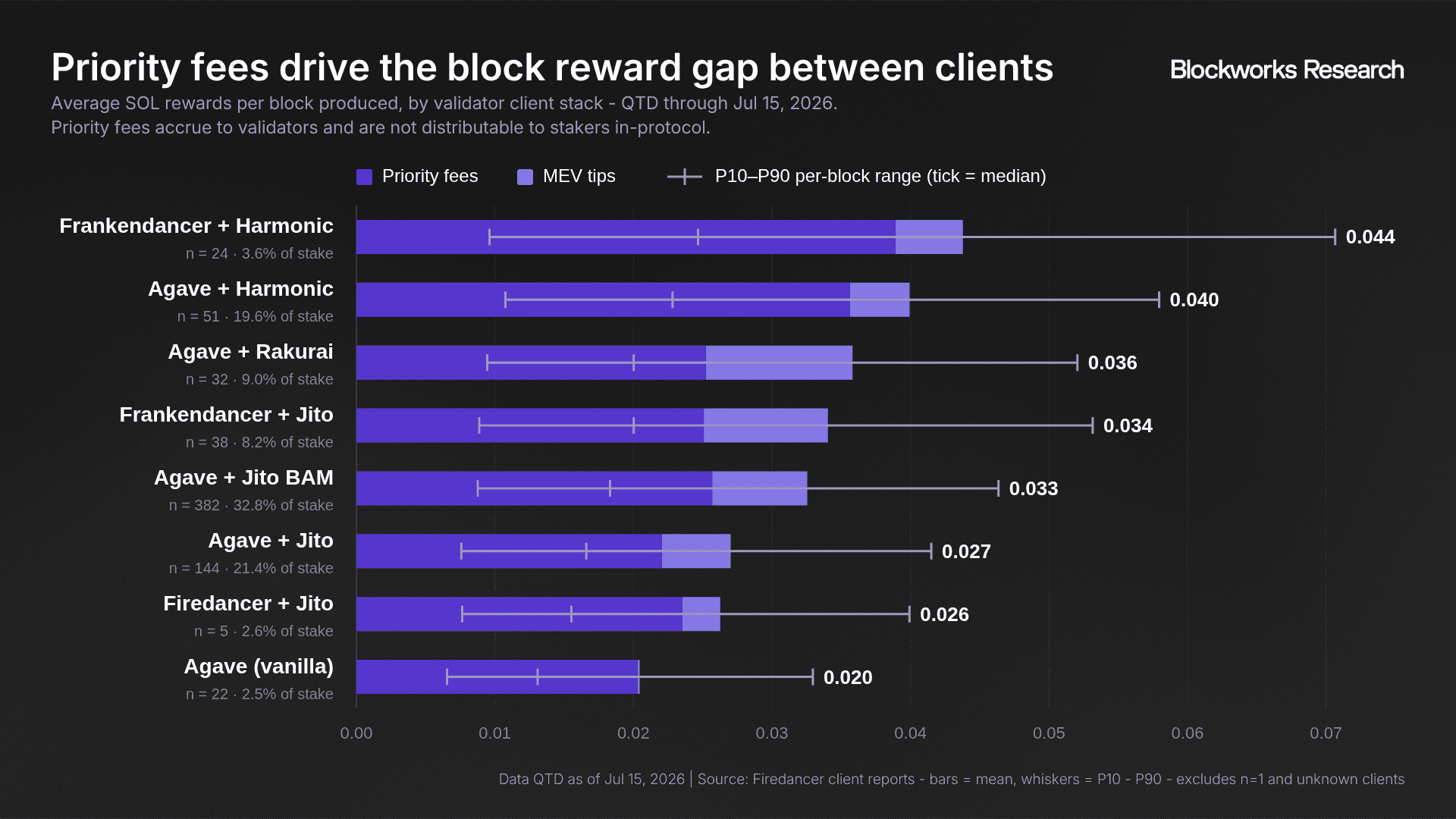
Look at what makes up each bar in the chart above. Almost all of it is priority fees, and priority fees go to the validator that produces the block, not to the stakers who delegated to it. So while a Frankendancer-Harmonic validator earns more than twice as much per block as one running vanilla Agave (0.044 SOL vs. 0.020), its stakers earn almost the same: median observable APY across these stacks sits within a 35 bps band. The extra revenue exists, it just stops at the validator level. As mentioned, some validators pass priority fees through third-party arrangements, but those flows are hard to track, and a delegator has no way to tell who shares or how much. SIMD 123 would make this visible onchain.
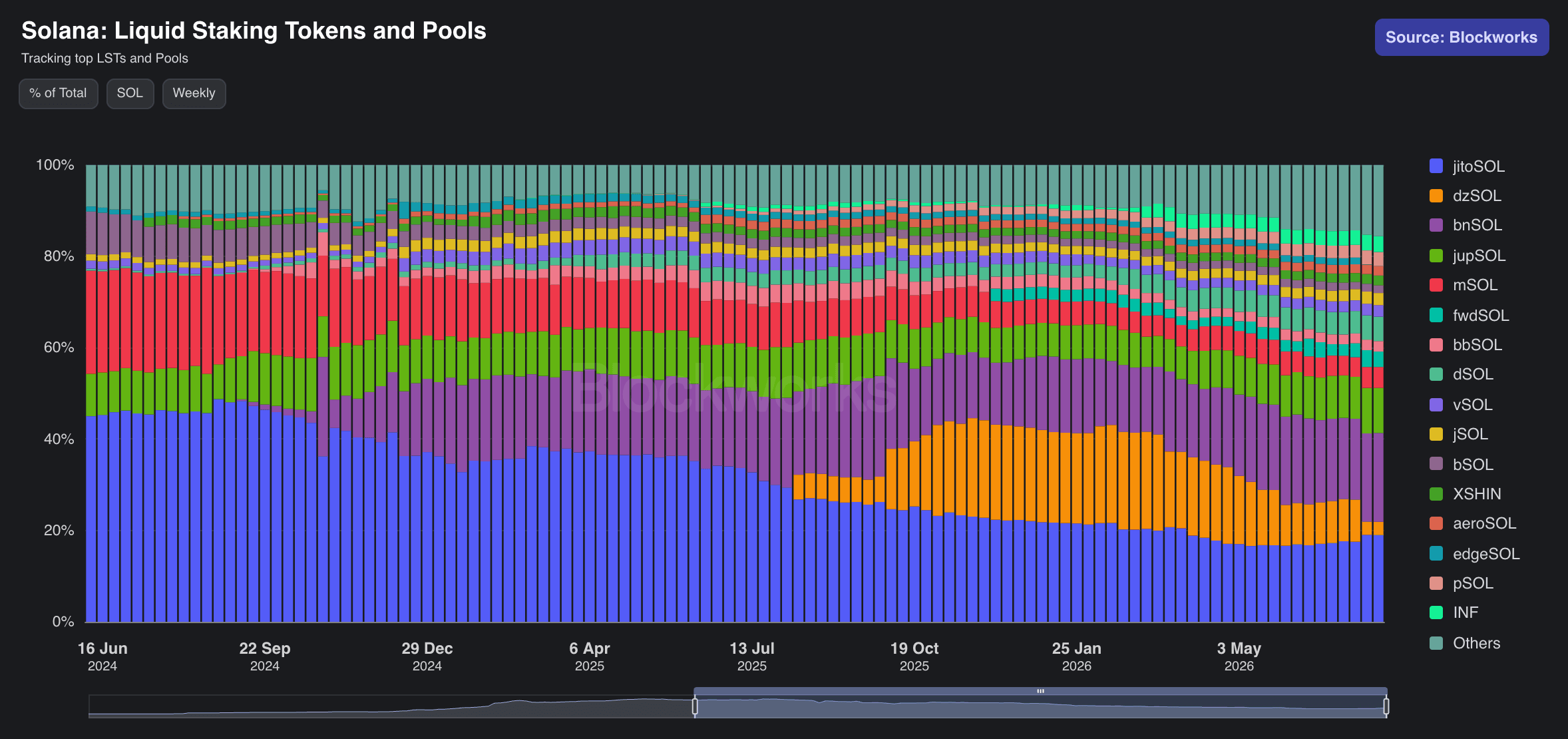
The liquid staking market, meanwhile, has consolidated toward distribution. Binance's bnSOL ($781M) and JitoSOL ($773M) lead, with jupSOL third at roughly $405M. mSOL ranks fifth at $188M, a roughly 5% share of the LST market. Exchange- and app-issued LSTs win on distribution. That is a structural headwind for standalone LST issuers that no delegation mechanism offsets, and any honest assessment of Marinade's position has to take that into account.
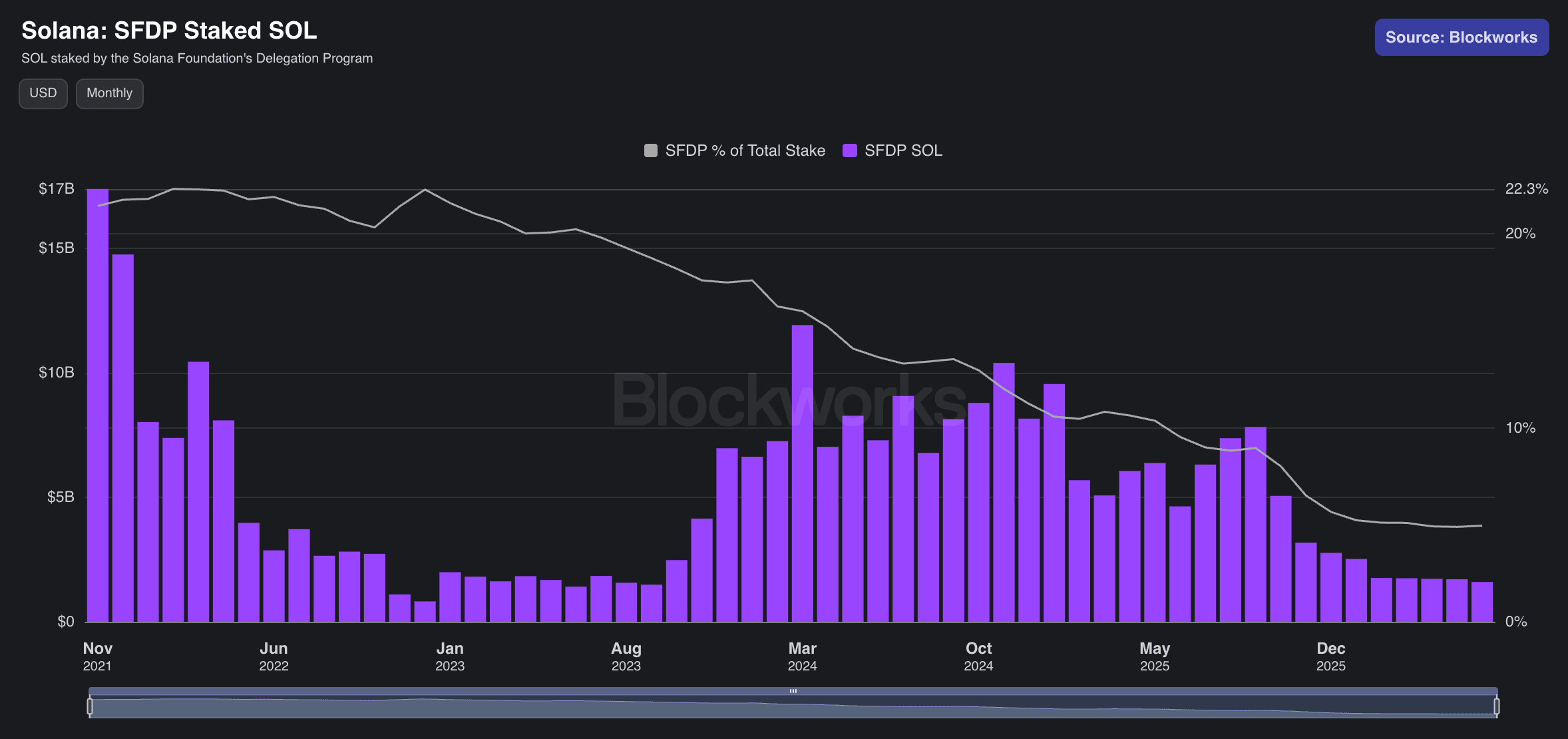
Two other features of the landscape are worth noting briefly. First, the Solana Foundation Delegation Program still accounts for roughly 5% of delegated stake, though it has declined steadily since 2022 and is expected to keep shrinking.
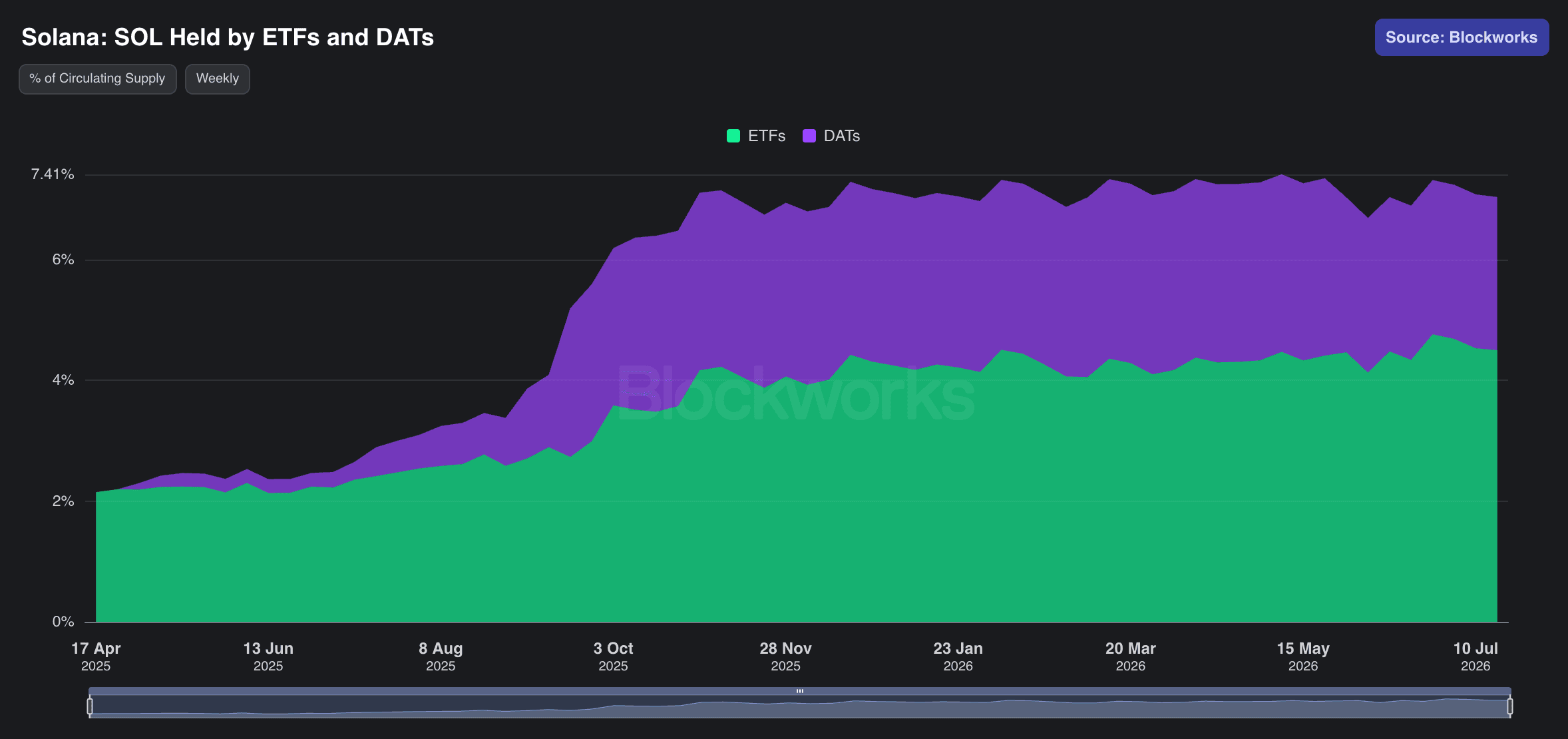
Second, and more importantly, institutional ownership has arrived faster than institutional staking: ETFs hold 4.39% of SOL supply and digital asset treasury companies (DATs) another 2.55%, roughly tripling their combined share since April 2025. These holders operate under custody and compliance constraints that most retail staking rails were not designed for. It is a demand profile the market is only beginning to serve.
 Marinade's April 2026 integration with Anchorage Digital is the most direct response to that demand so far. Institutional clients can now stake SOL through Marinade directly on Anchorage's platform and its Porto self-custody wallet. Assets never leave qualified custody: they remain in cold storage at Anchorage Digital Bank N.A., the first federally chartered crypto bank in the US approved to offer staking, throughout the staking lifecycle. That matters because qualified custody with cold-storage segregation is a paramount requirement for ETF issuers and other regulated allocators. The mechanism that makes it possible is native Solana plumbing rather than a wrapper: staking authority and withdrawal authority are separated at the stake-account level, so clients delegate staking operations to Marinade while Anchorage retains custody and control of the assets.
Two strategies are offered. Marinade Select delegates exclusively to a curated set of roughly 30 KYC-verified validators and is aimed at ETF issuers and other regulated products. Marinade Max Yield allocates dynamically across the full SAM validator set for allocators optimizing risk-adjusted performance. For the ETF issuers and DATs described above, this is the shape the missing rails take: custody-compatible access to the same auction-driven yield that retail stakers reach through SAM.
Part 3: Marinade, Routing the Fee Era to Stakers
Three custody models, one delegation engine
Marinade operates three staking products distinguished by custody model.
- Liquid staking mints mSOL against SOL deposited to the protocol's pool: custody transfers to the protocol, and the holder gains DeFi composability and instant-unstake liquidity.
- Native staking uses Solana's dual-authority design. The user keeps the withdraw authority, meaning only they can move funds, while Marinade holds only the stake authority needed to optimize delegation across validators.
- Marinade Select applies the same native-custody architecture to a curated, vetted validator set with daily position tracking. It is the institutional wrapper.
None of the three solutions currently charge deposit or management fees. Instant withdrawals incur a liquidity-based fee, while standard-cooldown withdrawals are free.
In terms of traction, Marinade's total delegated stake declined from 10.3M SOL a year ago to 6.5M SOL today, representing roughly 1.5% of network stake. mSOL fell from 5.0M to 2.4M SOL and Native from 5.3M to 2.9M. The proximate cause is visible below: the LST market consolidated toward exchange-issued tokens, most of them powered by Sanctum.
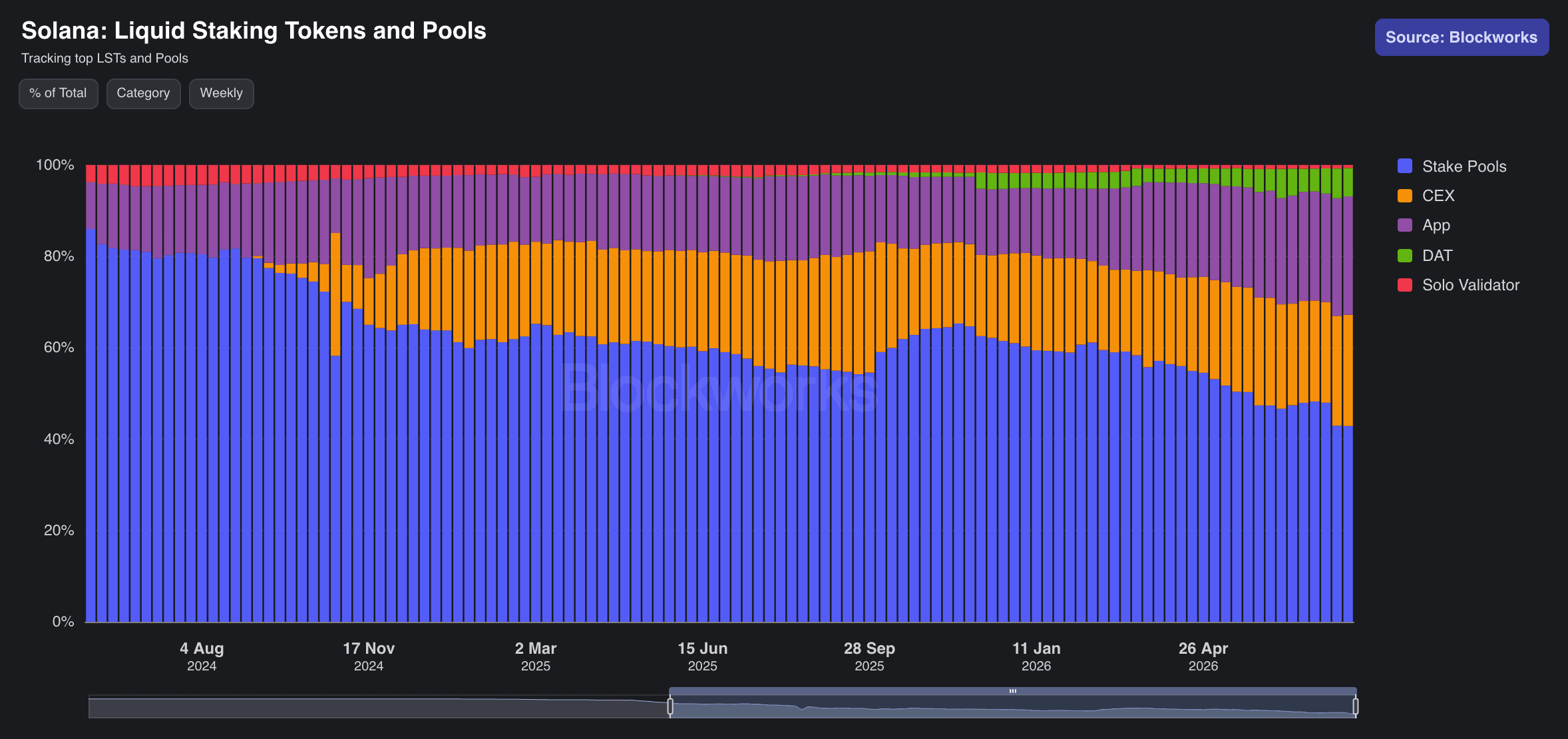
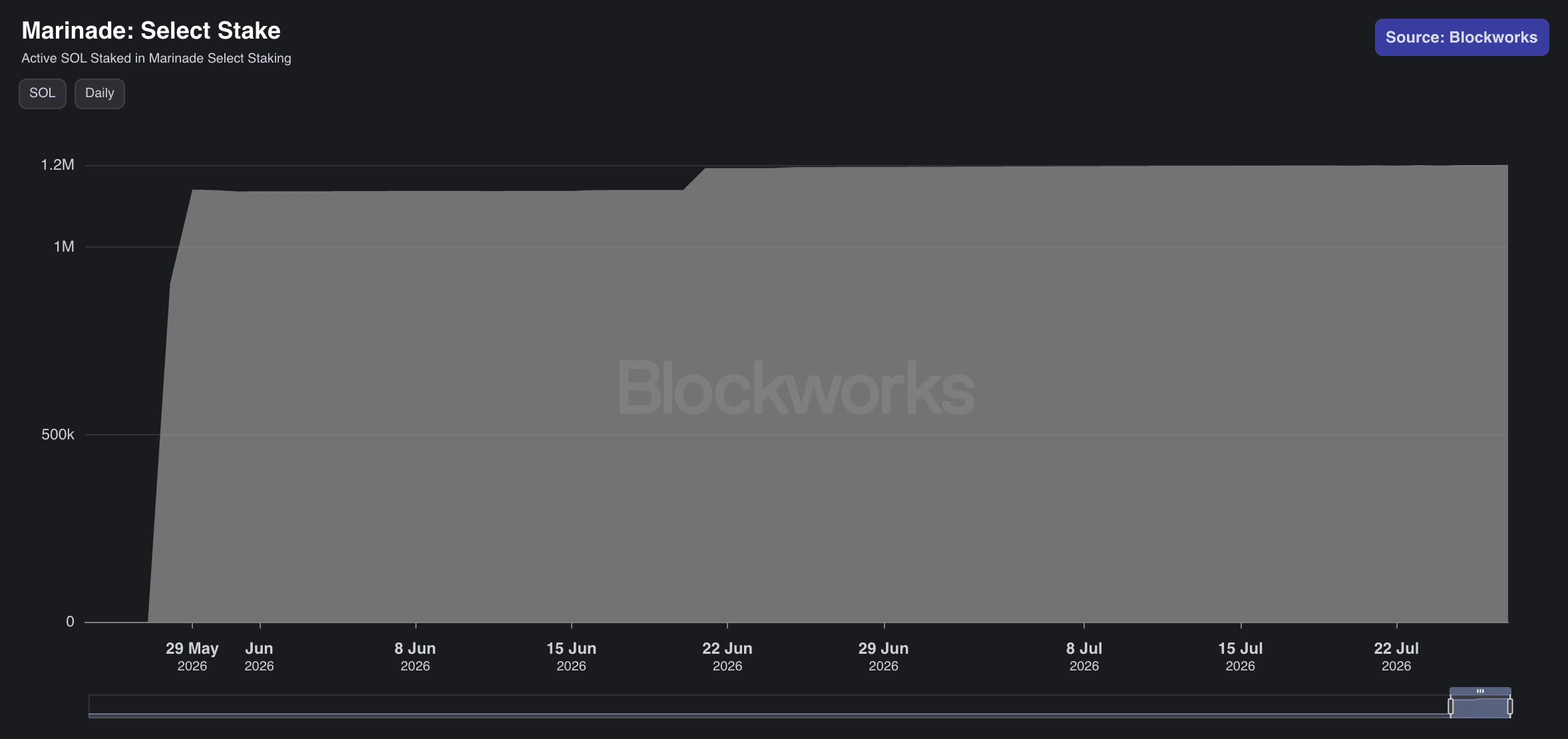
Two countervailing facts define the current trajectory. The base has stabilized and turned, with total stake up about 6% over the past three months. And nearly all of that growth is Select, which now holds 1.22M SOL, already 19% of Marinade's assets. The mix is shifting from the commodity LST business, where distribution wins, toward custody-preserving delegation, where institutional requirements set the terms.
SAM: the market's answer to the SIMD 123 gap
The Stake Auction Marketplace, launched August 2024, is the delegation engine behind all three products. How does it work? Validators want Marinade's stake because more stake means more blocks and more revenue. To get it, they bid: each validator states how much extra yield it will pay Marinade's stakers, on top of baseline staking rewards, per epoch. Marinade ranks the bids and delegates its stake to the highest ones. Validators fund those payments from whatever their operations earn, priority fees included, and back them with an onchain bond posted upfront. The bond is charged each epoch to pay stakers what was promised, and it is slashed automatically if the validator raises commissions or goes offline after receiving stake.
Since launch, validators have paid $27.5M in cumulative bids through SAM, currently running around $48K per week. This is fee-era validator revenue contractually routed to stakers.
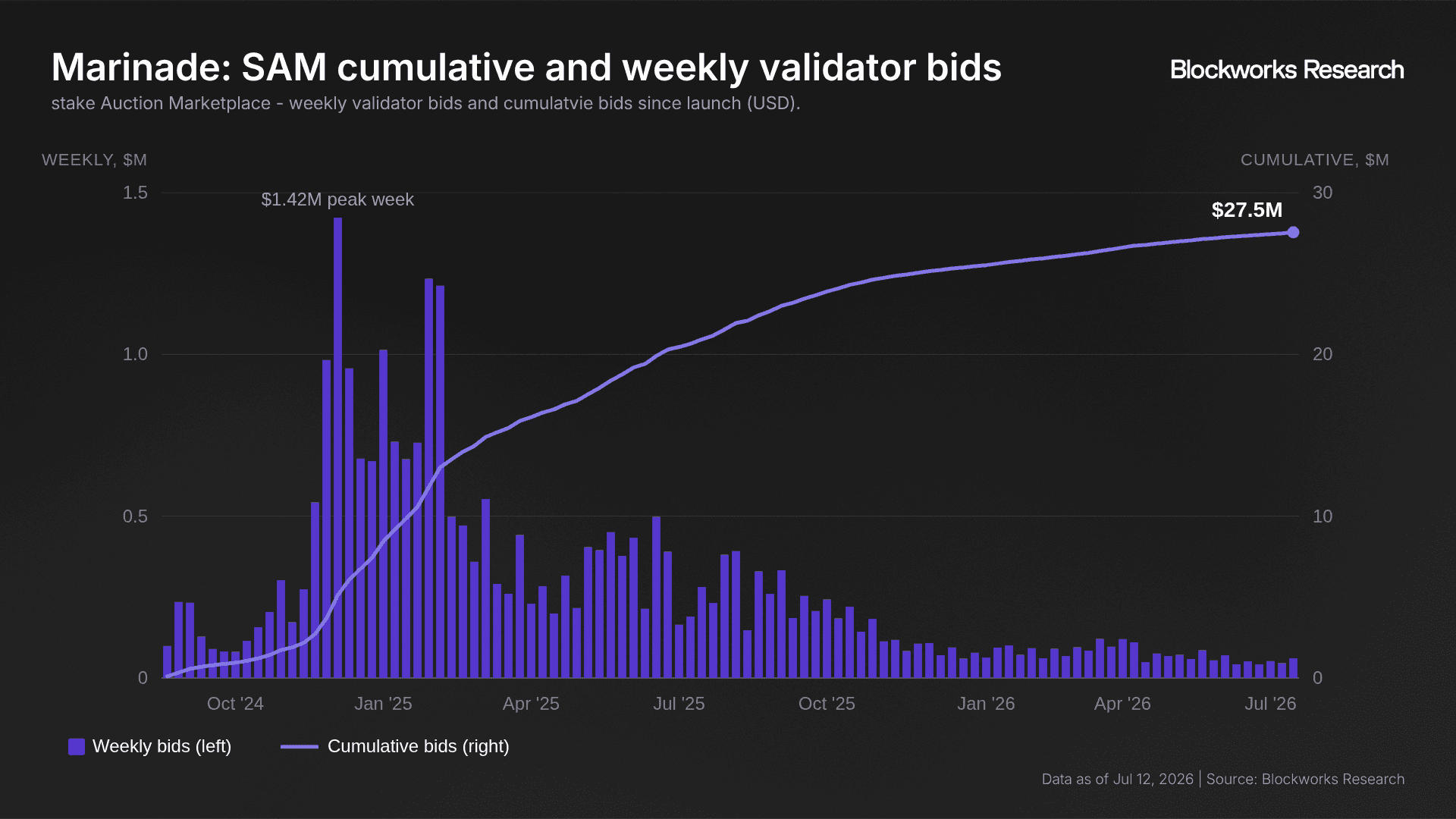
The positioning relative to SIMD 123 should be stated precisely. SIMD 123 would standardize the channel: an in-protocol way for any validator to share fees with its stakers. SAM prices the terms: a competitive auction that discovers how much of its revenue each validator will part with, enforced by slashable bonds. If SIMD 123 ships, SAM's auction could remain useful as the pricing layer on top of a standardized channel rather than a workaround for its absence.
Whether it works is an empirical question, and the data is constructive. Before SAM launched, Marinade's staker yield ran below the network baseline on every single day in our sample: mSOL averaged -105 bps and Native -66 bps versus network net staking APY, with zero positive days. Since launch, both run structurally above baseline, at +55 and +58 bps on average, positive on 84% of days and on 98 to 100% of days over the trailing twelve months. As of July 15, 2026, mSOL yields 5.72% and Native 5.75% against a 5.43% network baseline.
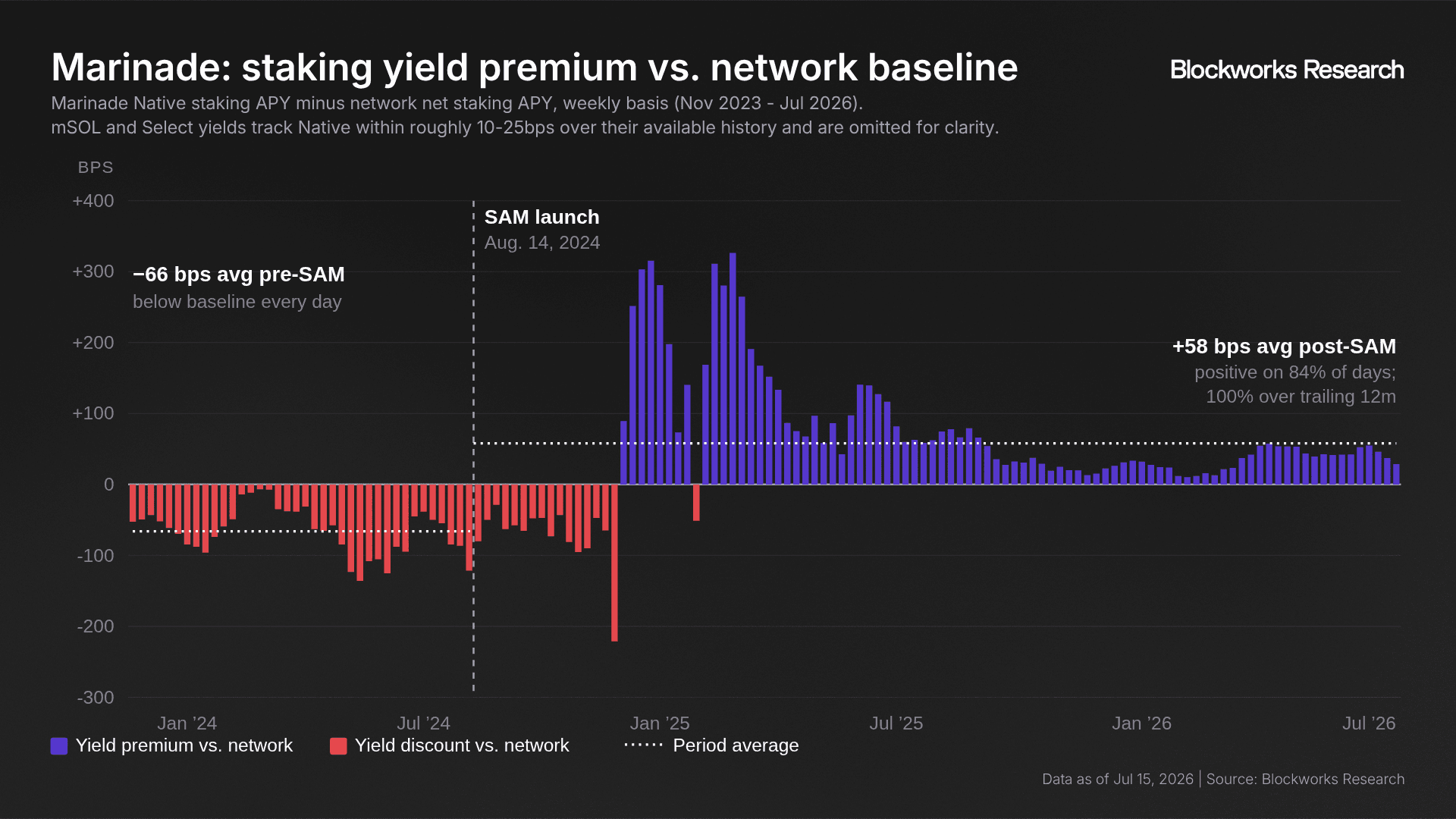
An important caveat is that Marinade removed mSOL's 6% fee on staking rewards in August 2024, six days after SAM launched. Roughly 40 bps of mSOL's improvement is therefore fee removal rather than auction proceeds. The headline comparison accordingly uses Marinade Native, which has never charged a management fee. Its swing from −66 bps to +58 bps versus baseline is fee-clean and attributable to delegation economics alone. Of note, Marinade's revenue comes from a performance fee on validator bids, so the premium shown is net of the protocol's cut.
The premium has compressed as the auction matured: it averaged +86 to +88 bps across 2025 and +32 to +36 bps year-to-date in 2026. In any case, the key takeaway is not that the premium is large. It is that the premium is persistent, positive, and mechanically attributable.
The institutional layer
Part 2 showed institutional SOL ownership tripling while institutional staking infrastructure lags behind. Marinade's answer is built into how Solana staking works rather than added on top. A Solana stake account has two separate permissions: one to move the funds, one to choose validators. The institution, or its custodian, keeps the first. Marinade only ever holds the second. The SOL never moves, and the institution can revoke Marinade's role onchain at any time, with no one's permission needed. Select adds what regulated allocators require on top of this: a vetted, KYC-verified validator set and daily position tracking.
Marinade Select is the exclusive staking provider for the Canary Marinade Solana ETF (SOLC, launched Nov. 18, 2025), with the fund structured to pass 100% of staking rewards through to investors. Select's recent ramp suggests that institutional demand is rising.
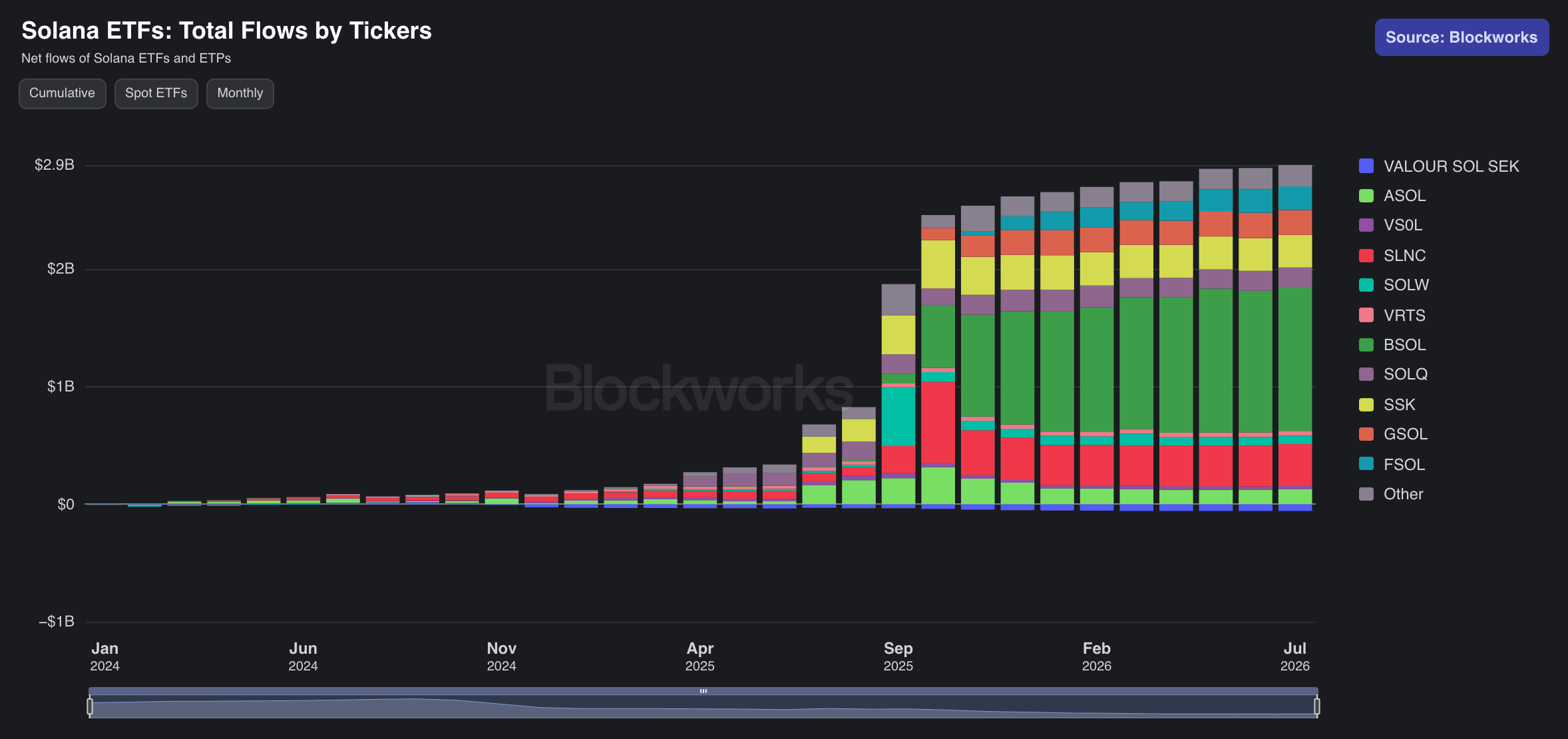
Cumulative net inflows into Solana ETPs have surpassed $2 billion over the past year, with most of the acceleration arriving after the US spot ETF launches in H2 2025. ETFs need staking: an unstaked SOL fund is uncompetitive when rivals pass yield through, so staking is becoming standard across issuers. In this regard, ETF issuers want the highest yield they can get, since every basis point of staking performance is margin they can either keep or pass on to compete for flows. That is the opening for Marinade: auction-driven delegation is built to maximize staker yield, and Select delivers it in the custody-compliant form ETFs require.
Conclusion
Solana’s roadmap is reshaping validator economics. Priority fees now account for the majority of operator revenue, while staker returns remain tied primarily to a declining issuance schedule. Against that backdrop, Marinade continues to play a meaningful role in Solana staking, and should continue to do so if SIMD 123 is implemented.
SAM and SIMD 123 are best viewed as complementary. SIMD 123 would standardize the mechanism through which validators share fee revenue with stakers, while SAM would competitively determine how much of that revenue validators are willing to share. As issuance declines and staking returns become increasingly fee-driven, mechanisms that allocate stake based on validator performance and fee-sharing terms should become more important.
Institutional adoption represents another potential growth vector. ETFs, DATs, and other large allocators are likely to evaluate staking providers based on custody, compliance, operational reliability, and net yield – the requirements Marinade Select was designed to address. Marinade enters this phase with both a functioning stake-auction system and an institutional product already in the market.
Several developments would warrant reassessing this outlook. These include SIMD 123 materially reducing the differentiation offered by SAM, auction premiums compressing as validator competition evolves, a slower-than-expected ramp in Marinade Select, or institutional staking demand concentrating within exchange- and custodian-native products. Changes to Solana’s issuance and fee-burn roadmap could also affect the pace at which validator selection and fee-sharing become more consequential.
The information contained in this report and by Blockworks Inc. and related affiliates is for general informational purposes only and is not intended to provide legal, financial, or investment advice. The report should not be construed as an offer or solicitation to buy or sell any security, token, or financial instrument and does not represent any recommendation or endorsement of any investment or financial product or service. Blockworks Inc. and related affiliates are not registered as a securities broker-dealer or an investment advisor in any jurisdiction or country.