ERC 8004: Introducing Trust for AI Agents
Key Takeaways
- ERC 8004 is a new trust layer for AI agents. It gives agents a portable onchain identity, reputation history, and validation record that can be reused across apps and marketplaces instead of being trapped inside closed platforms.
- Trust is the missing bottleneck for agent adoption. Agent-managed AUM remains small at roughly $69.8M versus a $13.3B onchain vault TVL, showing that capital is still hesitant to delegate to autonomous systems without stronger security guarantees.
- ERC 8004 introduces three core building blocks. The Identity Registry standardizes how agents register and stay discoverable, the Reputation Registry tracks performance over time, and the Validation Registry supports higher-stakes verification beyond simple reviews.
- Launchpads and frameworks could be major beneficiaries. Protocols like Virtuals, AI16z, and Openserv sit at the distribution layer where agents are created, registered, and shipped, making them natural gateways for ERC 8004 compliant identity and reputation from day one.
- Agent-to-agent coordination platforms may see rising demand. Infrastructure like Virtual’s ACP, Santa, and Nevermined becomes more valuable as agents start delegating work to each other based on reputation, with these platforms handling messaging, task execution, and payments once trust is established.
- Validation providers stand to benefit. Protocols like Phala benefit as users shift from relying on reviews to demanding proof that agents operated securely, using attestations and verification as stronger trust signals for sensitive or high-value work.
- Narratives need adoption and a viral moment to break out. Similar to x402, ERC 8004 likely needs major Web 2 integrations plus one breakout agent to pull attention and liquidity into the ecosystem. The launch on mainnet on January 29 and the launch event in February are near-term catalysts to watch.
Introduction
AI agents continued to make strides throughout 2025 in becoming part of mainstream life. While the future seems bright, significant infrastructure and safety rails still need to be in place to make this a reality. X402, introduced in May 2025 by Coinbase, was a major step forward that enabled AI agents to autonomously pay for web services using stablecoins without manual intervention. This allowed agents to discover, access, and pay for resources directly over HTTP, and helped move agents closer to true autonomy.
The next step is trust. In a world where many agents exist, it is hard to know which agent is best suited to carry out a task skillfully before entrusting it with funds. This is where the ERC 8004 framework comes in. It aims to give AI agents a portable onchain identity for reputation and verification so they can be trusted without relying on centralized platforms. The end state is a yellow pages style directory for AI agents that lets anyone discover agents, view their reputation score, and verify their work, all onchain in a decentralized way.
The Problem ERC 8004 Aims to Solve
Today’s AI agent ecosystem lacks a standardized way to establish trust across platforms and organizations. Agents are largely discovered through closed marketplaces or proprietary APIs, while reputation and performance data remains siloed inside individual platforms. This makes it difficult for users, applications, or other agents to reliably assess an agent’s quality, verify past behavior, or distinguish reputable agents from malicious or low-quality imitators.
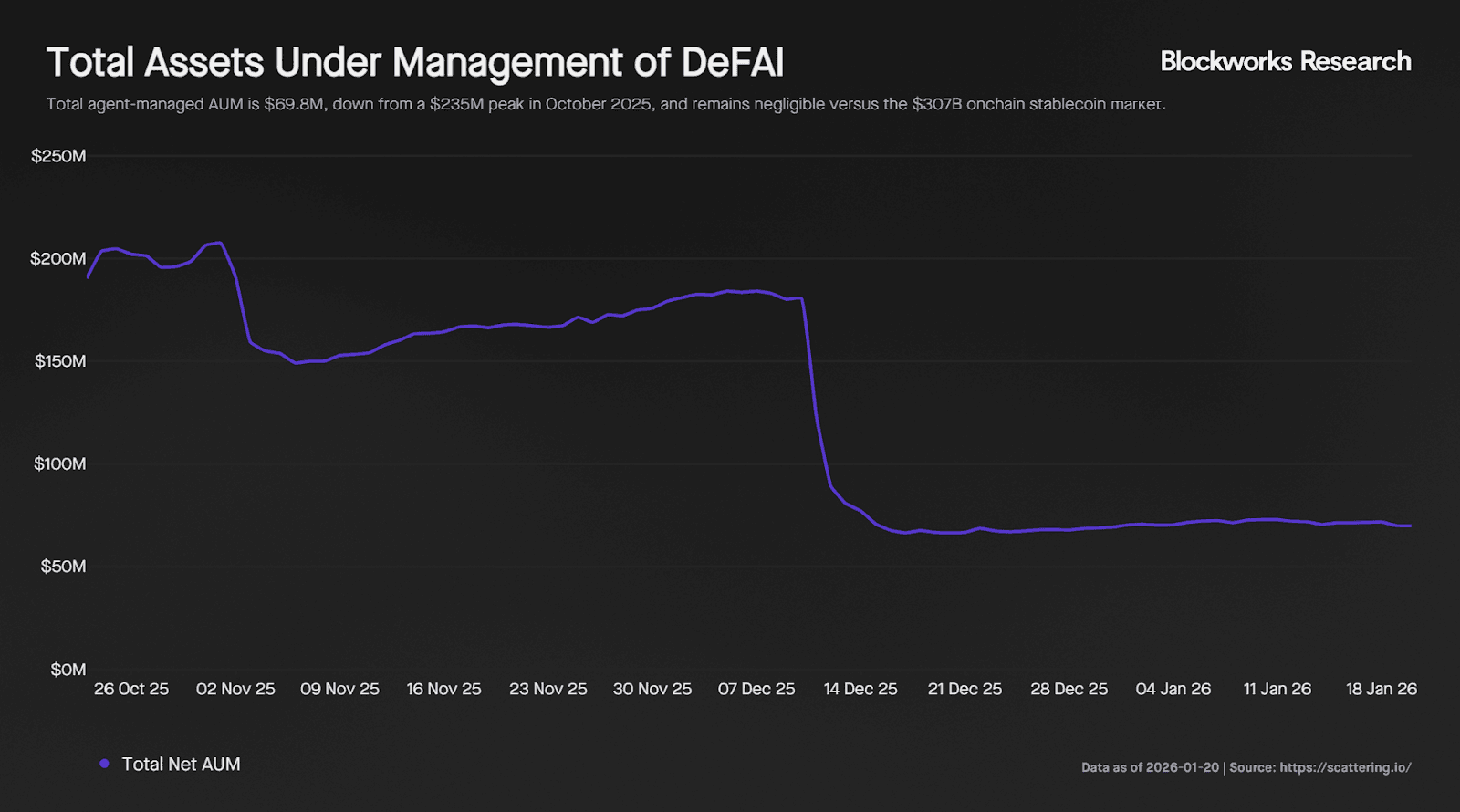
Total AUM managed by agents currently only sits at $69.8M, down from the peak of $235M in October 2025. The top three agents by AUM are Giza, ZyFAI, and Mamo, and all are focused on optimizing yields on idle capital. Current AUM under agents is small compared to the $13.3B deployed in risk curators and onchain capital allocators.
Agents have long been positioned as the future of finance and personal capital management, but onchain metrics show adoption has lagged. A key bottleneck is the lack of transparency in an agent’s decision-making process, alongside fears of AI hallucination. In a future where agents transact autonomously, coordinate with other agents, and handle real economic value, verifiable reputation, and execution-level accountability become must-have features.
Where ERC 8004 Fits In
ERC 8004, titled Trustless Agents, was introduced as an EIP in August 2025. The authors include Marco De Rossi of MetaMask, Davide Crapis of the Ethereum Foundation, Jordan Ellis of Google, and Erik Reppel of Coinbase.
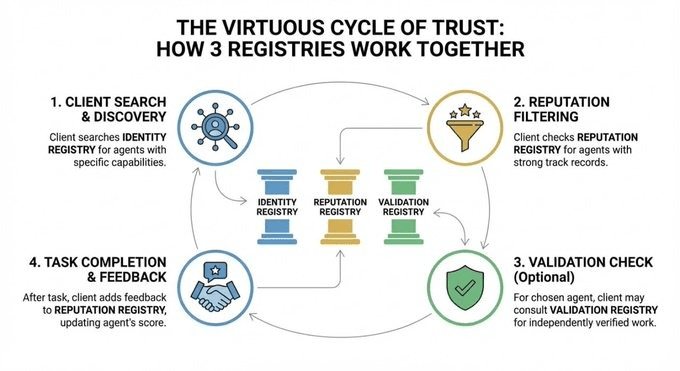
ERC 8004 is designed to sit alongside other emerging agent protocols rather than replace them. Standards such as Anthropic’s MCP and Google’s A2A focus on how agents communicate and coordinate tasks. ERC 8004 addresses a different layer of the stack, which is identity, reputation, and verification. ERC 8004 achieves this through three interoperable components, which are an Identity Registry, a Reputation Registry, and a Validation Registry.
Source: Ethereum Foundation
Identity Registry
The first component of ERC 8004 is the Identity Registry, which gives each agent a persistent onchain identity. Agents are represented as ERC 721 non-fungible tokens, and ownership of the token corresponds to control over the agent’s identity. Ownership can be transferred or delegated if the agent changes hands or is managed by multiple operators.
Each agent’s identity token points to a registration file that serves as the agent’s public profile. This profile describes what the agent does and how it can be contacted, including communication endpoints, wallet addresses, and supported protocols. By standardizing this registration format, ERC 8004 enables agents to be discovered and indexed across ecosystems in a consistent way. Importantly, identity is decoupled from any single marketplace or runtime environment. An agent’s identity persists even if platforms shut down, policies change, or the agent moves across chains.
Once registered, the agent becomes discoverable by users, applications, or other agents. This identity layer establishes the foundation for trust, but it does not itself indicate whether an agent is reliable or competent. That information is built over time through reputation and validation.
Reputation Registry
The Reputation Registry records feedback about agents based on completed work. After an agent performs a task, the party that received the work, referred to as the client, may submit feedback in the form of a numerical score ranging from 0 to 100, along with optional contextual information. Clients may be human users, applications, other agents, or smart contracts. Over time, this creates a public, queryable history of how the agent has performed across different tasks and clients.
To reduce spam and ensure feedback reflects real interactions, ERC 8004 requires agents to explicitly authorize which clients are allowed to submit reviews. This authorization is issued as a cryptographic permission tied to a specific agent and client address, and it may include limits on when and how often feedback can be submitted. Once feedback is submitted, it is recorded onchain as an immutable entry that cannot be edited or deleted, ensuring that reputation data remains auditable and tamper-resistant.
The reputation registry includes safeguards designed to prevent common manipulation strategies:
- Agents are prohibited from submitting feedback about themselves.
- Authorizations include expiration times, so reviews can only be submitted within a defined window after an interaction, which reduces the risk of delayed or opportunistic feedback.
- Index limits restrict the number of reviews a client can submit under a single authorization, which limits the impact of spam reviews by the same client.
ERC 8004 also incorporates mechanisms for dispute handling without compromising historical integrity. Clients retain the ability to revoke feedback they previously submitted if errors are discovered or disputes are resolved, but revocation does not erase the original entry. Instead, the feedback is marked as revoked, which preserves the original record while clearly signaling that it should no longer be considered active. Agents may append responses to feedback entries to provide context, clarification, or rebuttals, but these responses do not alter the original score.
This approach maintains a transparent, append-only reputation history, allowing participants and third-party evaluators to assess both the original feedback and any subsequent developments.
Validation Registry
For higher-stakes use cases, ERC 8004 introduces a Validation Registry that allows agents to request independent verification of their work. Instead of relying solely on client judgment, agents can submit evidence for third-party review and have the results recorded onchain.
Multiple validators may assess the same task, enabling applications to rely on consensus or validator reputation rather than a single source of truth. Over time, validation histories accumulate alongside reputation data, allowing clients and protocols to distinguish between agents that merely receive positive feedback and agents whose work has been independently verified under rigorous conditions.
Validators may use different methods depending on the nature of the task and the level of assurance required. For deterministic workloads, validators may re-execute the same computation independently and stake capital to back their result, creating economic incentives for honest verification.
For tasks where re-execution is impractical or where intellectual property must be protected, validators may instead rely on cryptographic proofs or trusted hardware environments. Zero-knowledge proof systems can attest that a specific model was run on specific inputs and produced a specific output without revealing the underlying model or data. Trusted execution environments provide hardware-based attestations that verification logic was executed inside secure enclaves, producing signed proofs that can be checked onchain. These approaches allow validation of complex or sensitive agent behavior while preserving confidentiality.
Traction Thus Far
The framework will be going live on Ethereum mainnet and Base on Jan. 29 2026. Currently, ERC 8004 contracts are deployed on six testnet environments, which include Base Sepolia, Ethereum Sepolia, Linea Sepolia, Polygon Amoy, Optimism Sepolia, and Hedera. Base Sepolia served as the main testing environment for ERC 8004, with all three registries deployed and fully functional.
The mainnet launch will be accompanied by a launch event in February. While details around the launch event have yet to be announced, it is likely to serve as a broader marketing push and could include partnership announcements and early integrations with the standard. The current testnet ERC 8004 registry has 486 agents, with the top 100 agents by score mainly deployed on Ethereum’s and Base’s Sepolia.
There’s usually a lag between a framework’s launch, its broader adoption by institutions and the Web3 ecosystem, and any tokens tied to the narrative starting to rally. x402 offers a clear lesson: Coinbase launched the framework months earlier on May 6, 2025, but partnerships announced* *in September drove the standard’s momentum. Examples include:
- Vercel (Sep. 12, 2025). Integrated x402 into its platform, allowing Next.js applications to use payable API routes.
- Google Cloud (Sep. 16, 2025). Integrated x402 into its Agent Payments Protocol to facilitate stablecoin payments for AI agents in the Google AI Agent Marketplace.
- Cloudflare (Sep. 23, 2025). Coinbase and Cloudflare launched the x402 foundation, which aimed to further the development of an open internet standard for digital payments.
- Visa (Oct. 14, 2025). Partnered with Cloudflare and Coinbase to align with x402 through its Trusted Agent Protocol for AI-driven checkout.
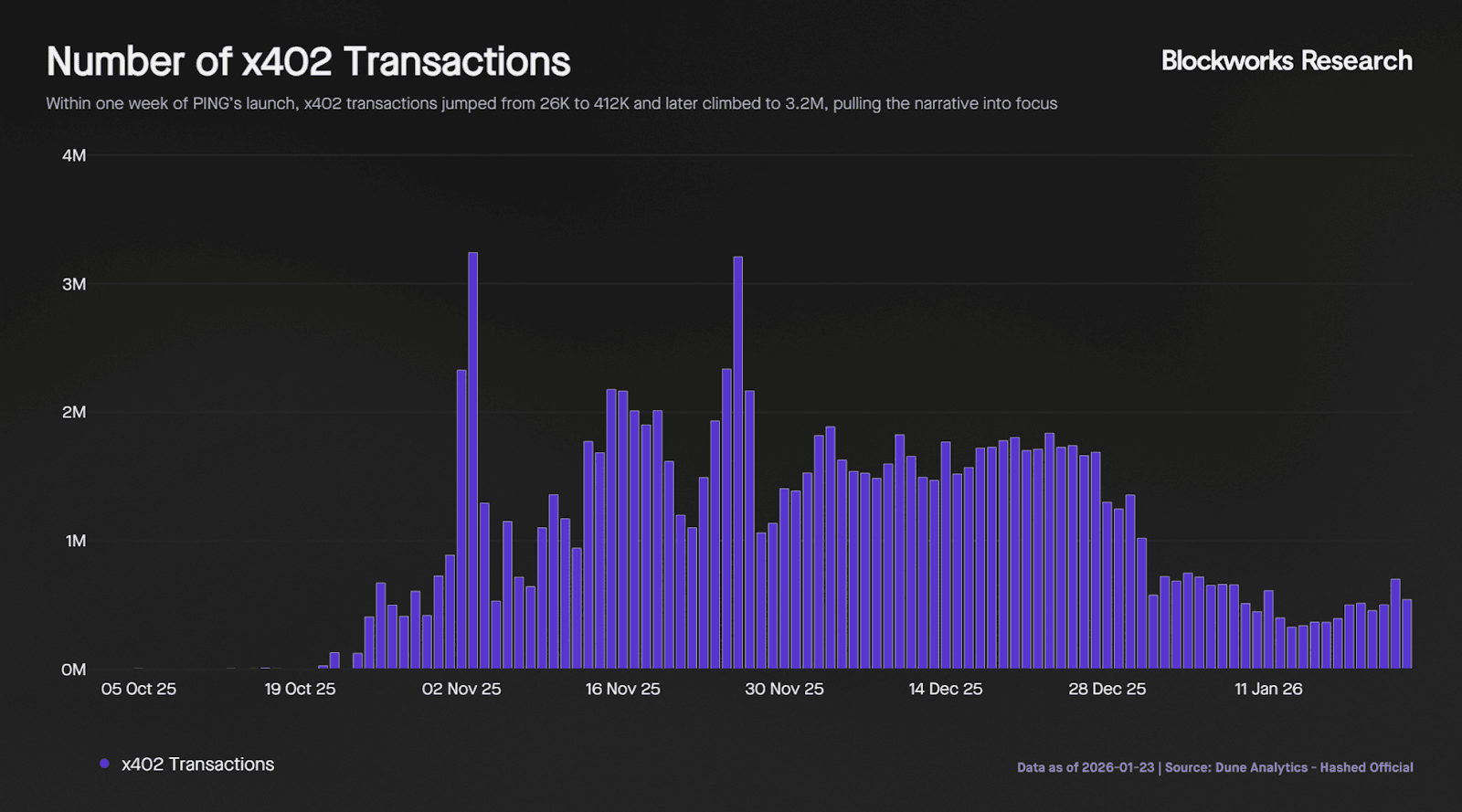
Protocols that rode the x402 narrative, such as VIRTUALS, GAME, SANTA, DEXTER, and PAYAI only rallied towards the end of October. This was driven by the launch of a memecoin, PING, which aimed to stress test the framework. Within a week of the launch of PING, x402 transactions spiked from 26K to 412K before continuing upwards and touching 3.2M. The virality created by PING, brought the x402 narrative front and center, and protocols adopting the x402 framework saw a surge in transactions.
If x402 is any guide, two things likely need to happen for ERC-8004 to win mindshare and for adjacent protocols to catch a narrative bid.
First, adoption by large Web2 AI platforms to give their agents an identity and a reputation score.
Second, the framework likely needs a viral agent moment. The agent could even mostly be a meme, but as long as it can rack up a reputation score and gain mindshare, higher quality agents will likely follow, similar to what happened with x402. The event in February is one to monitor closely for potential adoption announcements by institutions.
Which Infrastructure Layer Protocols Could Catch a Bid
AI Agent Frameworks and Launchpads
If the ERC 8004 narrative gains traction, AI agent launchpads and frameworks such as Virtuals, AI16z, and Openserv are positioned to benefit because they sit at the distribution layer where agents are created, deployed, and discovered. Launchpads and frameworks make it easier to ship agents with compliant identity setup, clean registration metadata, and integrations into validation systems from day one.
Over time, the strongest frameworks will not just help agents get deployed. They will also become a key discovery layer. In a world where trust becomes a core differentiator, launchpads that curate higher quality agents are likely to become default onramps for both developers launching agents and users selecting them.
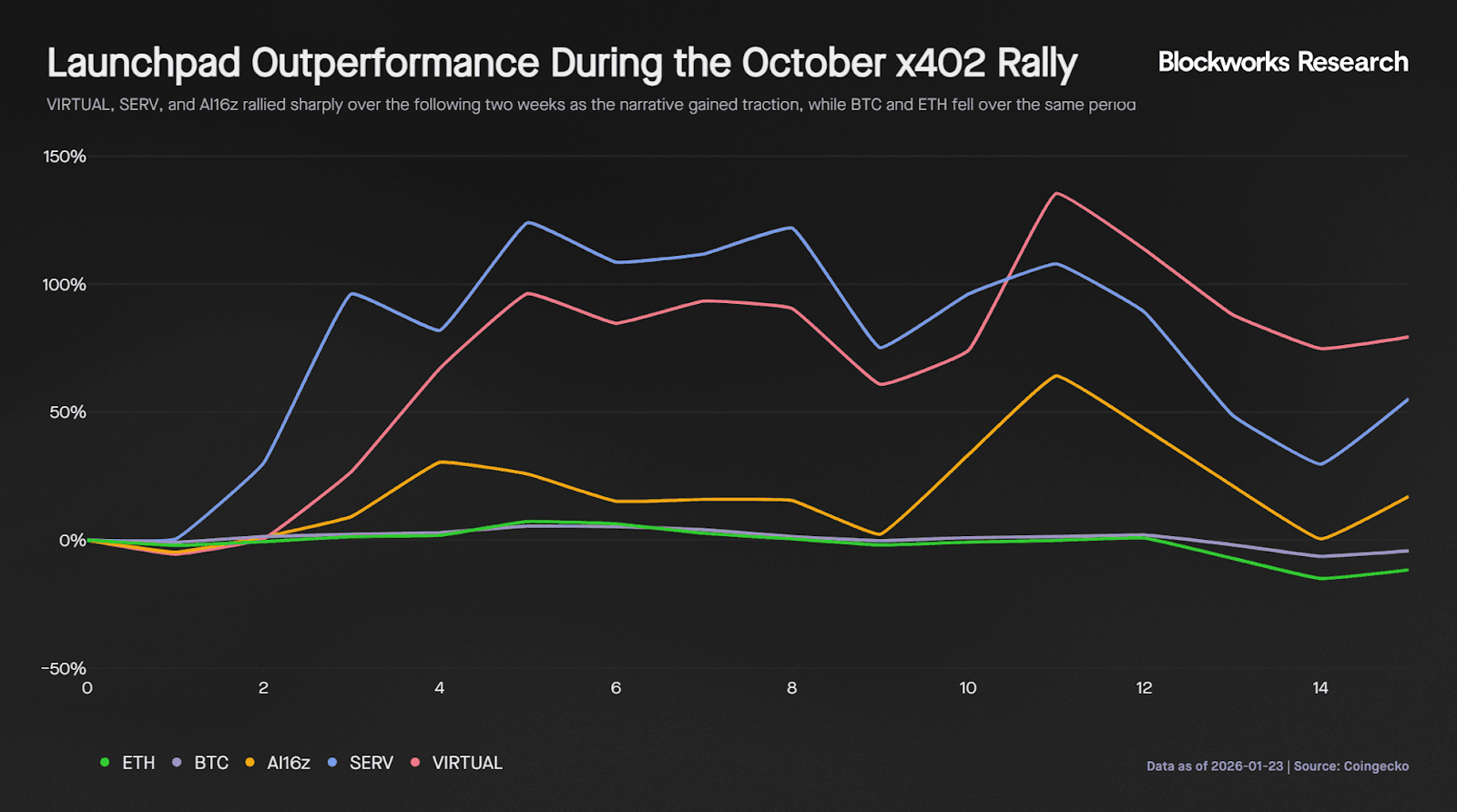
When the x402 meta kicked off in October, we can observe sharp outperformance of agent launchpads and frameworks versus BTC and ETH, which were down over the same period. VIRTUAL is the most liquid avenue for investors to gain exposure to the AI agent space, and it therefore tends to get the strongest bid when the sector picks up in activity.
Openserv has already highlighted that builders can use Openserv to build agentic applications with native x402 and ERC 8004 integrations, which lowers integration friction for teams that want to ship trusted agents quickly.
Agent-to-Agent Infrastructure
ERC 8004 makes it easier for agents to work together by giving them a shared way to check who is trustworthy before handing off a task. Instead of guessing whether another agent is reliable, an agent can look up its identity and reputation history, then choose the best specialist for the job. This supports a manager-style workflow where one main agent breaks a bigger task into smaller pieces and outsources them to other agents with strong track records.
Agent-to-agent infrastructure projects like Nevermined, Virtuals’ ACP, and SANTA benefit directly from this shift because they focus on making real agent teamwork possible in practice. ERC 8004 helps answer, “Who is this agent?” and “Can I trust it?” while these protocols handle the coordination layer, including messaging, task management, and payments. As more agents coordinate and transact autonomously, the platforms that make delegation and collaboration smooth become increasingly valuable. Nevermined and SANTA have already integrated with the ERC 8004 framework. Liquid avenues to gain exposure to agent-to-agent infrastructure include VIRTUAL, SANTA, and GAME, which power key parts of the Virtuals ACP ecosystem.
Validation Services
Protocols that provide validation services, such as Phala, could benefit significantly if ERC 8004 becomes widely adopted. As agents take on higher value tasks, users and applications will increasingly demand proof that an agent operated securely and as expected, not just positive reviews.
Validation networks address this by offering independent verification through trusted hardware and attestations, giving agents a stronger trust signal. Phala is a clear example of this approach, using TEE based attestations to prove the agent is running in a secure, trusted setup. By embedding these trust checks directly inside applications through its Trust Center widget, Phala reduces friction and lets users verify agent security without leaving the product.
Conclusion
ERC 8004 is designed to introduce trust into the AI agent stack by standardizing three core primitives, which are identity, reputation, and validation. If this framework reaches broader adoption, it could represent an Airbnb-style moment for AI agents, where users can discover agents through a marketplace like directory, evaluate track records, and rely on portable reputations, even if the host platform ceases to exist.
For ERC 8004 to gain mindshare, institutional adoption and a viral agent moment will likely be key catalysts, similar to the trajectory observed with x402. If the narrative gains traction, Virtuals stands out as a primary beneficiary because it supports multiple parts of the stack and remains one of the most liquid avenues for exposure. The upcoming mainnet launch and event in February are important near term milestones to monitor closely for major announcements that could catalyze broader adoption of ERC 8004 and drive renewed momentum across the agent infrastructure stack.
The information contained in this report and by Blockworks Inc. and related affiliates is for general informational purposes only and is not intended to provide legal, financial, or investment advice. The report should not be construed as an offer or solicitation to buy or sell any security, token, or financial instrument and does not represent any recommendation or endorsement of any investment or financial product or service. Blockworks Inc. and related affiliates are not registered as a securities broker-dealer or an investment advisor in any jurisdiction or country.