This research report has been funded by Allora. By providing this disclosure, we aim to ensure that the research reported in this document is conducted with objectivity and transparency. Blockworks Research makes the following disclosures: 1) Research Funding: The research reported in this document has been funded by Allora. The sponsor may have input on the content of the report, but Blockworks Research maintains editorial control over the final report to retain data accuracy and objectivity. All published reports by Blockworks Research are reviewed by internal independent parties to prevent bias. 2) Researchers submit financial conflict of interest (FCOI) disclosures on a monthly basis that are reviewed by appropriate internal parties. Readers are advised to conduct their own independent research and seek advice of qualified financial advisor before making investment decisions.

Decentralized AI Coordination: Transforming Siloed Intelligence into Collective Networks
Key Takeaways
- Crypto's reliance on centralized AI services creates an architectural mismatch that reintroduces single points of failure and trust assumptions, undermining the core principles that make blockchain infrastructure valuable.
- Decentralized AI coordination networks aggregate predictions from multiple models through permissionless marketplaces, creating powerful results that can compete with centralized solutions.
- Near-term adoption targets three high-value markets: DeFi applications, prediction markets, and AI agents.
- The decentralized AI coordination sector spans distinct architectural paradigms, from competitive intelligence marketplaces (Bittensor's subnet-based model selection), stake-weighted ensemble crowdsourcing (Numerai's tournament aggregation), to context-aware synthesis (Allora's performance-informed inference). Each optimize for different tradeoffs between model diversity, real-time adaptability, and coordination overhead, demonstrating that no single approach dominates across all use cases.
Introduction
Recent advances in AI represent a significant technological shift with distinct implications for Crypto. While blockchains have created a permissionless, trustless environment for apps to build upon, machine intelligence remains concentrated among centralized providers, creating an architectural mismatch that undermines Crypto's core value proposition. Crypto apps increasingly rely on centralized AI services that reintroduce single points of failure and trust assumptions. As we move into a future where autonomous agents manage portfolios and interact with decentralized financial applications, this dependence on centralized AI infrastructure represents a structural vulnerability the industry must resolve. Decentralized AI coordination networks aim to solve this problem by creating permissionless marketplaces where model providers contribute predictions that are synthesized into collective outputs.
The Convergence of AI and Crypto
Monolithic AI Creates Systemic Risk
The tremendous resources required to build cutting-edge AI models has concentrated intelligence in platforms controlled by technology giants. This centralization creates multiple systemic risks:
Infrastructure Vulnerability: Centralized AI services introduce single points of failure. API outages, rate limits, or service discontinuation can break applications entirely. For mission-critical financial applications managing potentially billions in assets, relying on centralized systems represents unacceptable operational risk. Some examples include an OpenAI major outage, or Anthropic tightening rate limits without telling users.
Trust Reintroduction: Applications built on trustless, decentralized infrastructure increasingly rely on centralized AI services that reintroduce trust assumptions blockchain technology eliminates. Users must trust that model providers act honestly, don't manipulate outputs for competitive advantage, and maintain consistent quality over time.
Lack of Transparency: Closed-source models operate as black boxes. Users cannot verify how models make decisions, audit for bias, or understand when models may be unreliable. For financial applications where incorrect predictions can cause material losses, this opacity creates risk.
Monopolistic Control: Centralized providers can modify pricing, restrict access, or change terms of service unilaterally. Applications built on these foundations lack sovereignty over their intelligence layer, creating strategic dependencies that undermine the permissionless composability that makes Crypto valuable.
The AI Coordination Problem
As AI models proliferate across Crypto applications, developers face a fundamental limitation: no single model performs optimally under all conditions. A machine learning model trained to predict bitcoin prices during stable markets, for instance, generates accurate forecasts when volatility is low, but deteriorates during market dislocations when risk management becomes critical.
The obvious solution, running multiple models in parallel, introduces challenges that decentralized coordination is uniquely positioned to solve. High-performing AI/ML models are resource intensive, requiring significant data, time, expertise, and capital to train and deploy. More critically, strong performance often depends on unique or proprietary training data, creating information silos where models cannot learn from each other's successes or share insights across complementary domains. This fragmentation limits the collective intelligence that could emerge from model aggregation.
DeFi has demonstrated how composable, programmable smart contracts can deliver step-change efficiency improvements over legacy systems. Decentralized AI coordination networks offer a similar opportunity to enhance model performance through collective intelligence.
Market Opportunity: Intelligence Infrastructure at the AI-Crypto Intersection
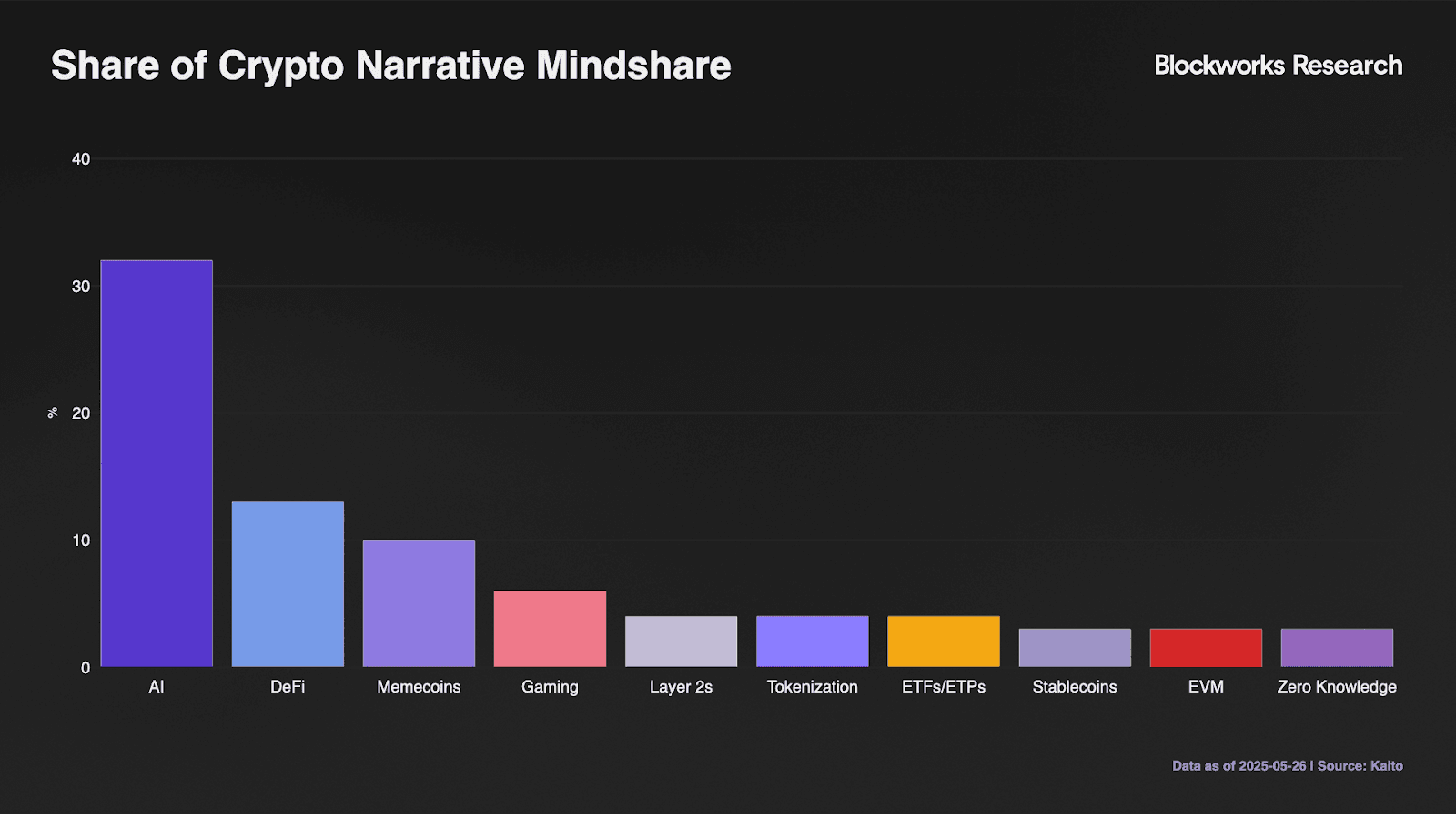
Decentralized AI coordination protocols target opportunities across AI infrastructure, generative AI, autonomous agents, DeFi, prediction markets, and other Crypto applications. Several protocols in this space have achieved multi-billion dollar valuations, reflecting investor expectations that decentralized alternatives will gain adoption where transparency, trustlessness, and data sovereignty provide competitive advantages over centralized providers. In 2025 AI agent projects have raised nearly $1.4 billion YTD, already a 9.4% increase over 2024 funding. Crypto-AI projects reached over 30% mindshare this year as well, indicating the extreme interest investors have in this space.
In the short term, decentralized AI coordination protocols aim to impact three key markets: DeFi, prediction markets, and AI agents.
DeFi: The integration of dynamic, AI-driven intelligence will allow DeFi protocols to evolve beyond their current rigid, rule-based smart contracts. Applications include AI-powered risk management (e.g., adaptive loan-to-value ratios that respond to real-time market risk), automated yield optimization strategies that intelligently allocate capital across protocols, and dynamic liquidity management that anticipates market movements to reduce impermanent loss.
Prediction Markets: Traditional prediction markets aggregate human beliefs and dispersed information to surface probabilistic truth, while AI coordination layers introduce algorithmic participants capable of learning from large, multi-modal datasets. This changes the market structure from purely social aggregation to hybrid intelligence coordination, where human judgment and machine inference operate in parallel. A decentralized AI coordination layer can also enhance these markets by enabling AI agents to act as highly sophisticated market makers. AI agents can make highly accurate forecasts and execute precise trades, thereby deepening liquidity and improving the accuracy of the market's predictions.
AI Agents: A coordination layer is the critical missing piece for creating truly sophisticated AI agents. It allows an agent to dynamically source the best-in-class intelligence for any input at runtime, making it able to tackle any general purpose task. For example, a DeFi trading agent could query one set of models for a price forecast, another for a volatility prediction, and a third for a risk assessment, composing these inputs to execute an optimal trade. This transforms agents from simple rule-based bots into adaptive, intelligent entities that can operate in fuzzy environments. Decentralized AI coordination networks are natural complements to AI agents that ultimately improve agent intelligence.
The Decentralized AI Coordination Network Landscape
The decentralized AI coordination sector has evolved into a diverse ecosystem of protocols, each taking distinct approaches to addressing the challenges of siloed intelligence. While projects vary in their technical architectures, they share a common goal of creating open, permissionless infrastructure that enables AI models to coordinate, compete, and collectively deliver superior intelligence without centralized control.
Allora Network: Context-Aware AI Coordination
The Allora Network enters the decentralized AI landscape with a distinct approach to solving the model fragmentation problem. Its architecture is purpose-built to enable context-aware coordination, aiming to be the intelligence layer for a new generation of AI-powered applications.
Architecture
Built as a Cosmos SDK app chain, Allora operates with full sovereignty over its execution environment. This allows the network to implement complex inference synthesis at the protocol level without the constraints of fluctuating gas markets. The network uses CometBFT consensus through Delegated Proof-of-Stake for fast transaction finality, while Cosmos IBC protocol enables interoperability with other blockchains.
The architecture organizes into three layers: The Inference Consumption Layer where consumers request intelligence, the Forecasting and Synthesis Layer where workers submit predictions and peer forecasts, and the Consensus Layer managing economic integrity and rewards.

Allora Network Layers (Source: Allora)
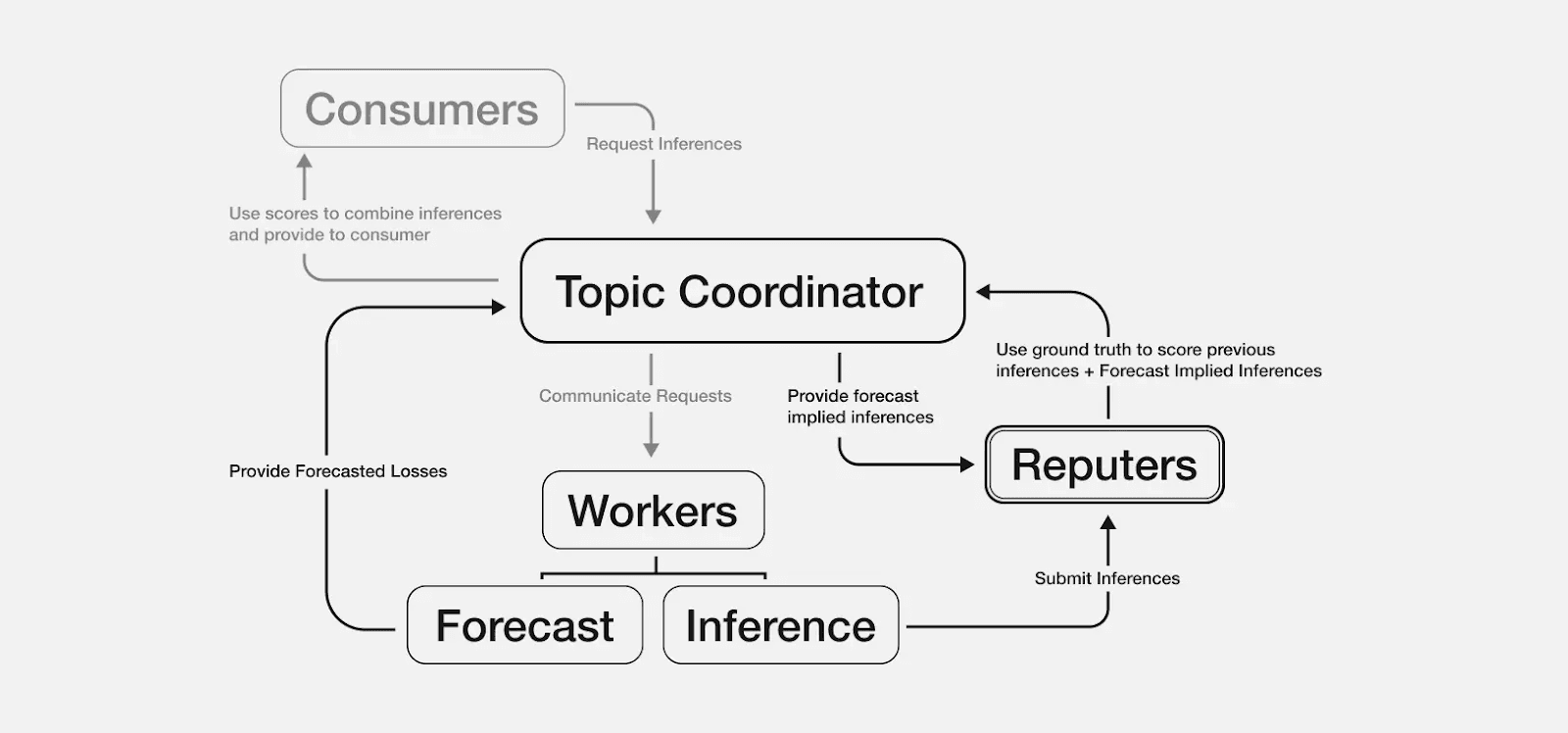
Allora's core value proposition lies in its inference synthesis mechanism. Workers submit direct inferences while simultaneously forecasting expected performance for peer models under the current circumstances. The protocol aggregates these peer-to-peer forecasts to derive consensus expectations of each model's real-time accuracy, producing inferences weighted by current expected performance rather than trailing historical metrics.
The network organizes intelligence markets through permissionless topic creation, where any participant can establish a topic coordinator defined by a target variable and loss function. These topics enable specialized intelligence markets for distinct prediction domains (price forecasts, volatility estimates, risk assessments) each operating as independent competitive environments. Reputers evaluate worker performance against ground truth data when available, providing the quality assurance layer that enables accurate reward distribution. This architecture separates model contribution from performance evaluation, creating adversarial incentives that prevent collusion while maintaining quality standards.
The synthesis layer combines two distinct signals: direct inferences weighted by long-term track records, and forecast-implied inferences weighted by context-specific accuracy expectations. Through normalized regret calculations, the protocol generates weights that determine each inference's contribution to the final network output. This architecture creates a self-reinforcing feedback mechanism that incentivizes both predictive accuracy and meta-model development, driving participants to build forecasting systems that capture performance variability across market regimes.
Allora Network Synthesis Mechanism (Source: Allora)
Economic incentives explicitly target decentralization through entropy-based reward distribution. The protocol allocates 25% of rewards to economic security providers (validators) and the remaining 75% to intelligence contributors (inferers, forecasters, and reputers). Within these three categories, each receives rewards proportional to their modified entropy, which measures reward concentration, with higher entropy indicating broader distribution. Within a topic, rewards flow proportionally to stake weight and revenue generation, while anti-centralization mechanisms like adjusted stake calculations prevent runaway concentration where dominant reputers capture disproportionate influence through self-reinforcing consensus alignment.
Network Privacy
Allora ensures privacy by soliciting inferences, not models. By restricting network traffic to prediction outputs rather than model weights or training data, Allora effectively decouples model execution from network consensus. This architecture allows participants to run proprietary, closed-source models offchain while submitting only the resulting inferences onchain.
The implication for network participants is a preservation of IP without a sacrifice in monetization capability. Because the inference synthesis mechanism relies exclusively on the outputs to determine accuracy and weight, sophisticated actors (e.g., quantitative hedge funds or enterprise developers) can monetize high-performance "black box" models without exposing their underlying edge, datasets, or strategies to the public ledger. This removes the primary economic disincentive for institutional participation in decentralized AI infrastructure.
Tokenomics and Incentive Alignment Mechanisms
The ALLO token is the native utility and governance asset of the Allora Network, designed to secure the protocol and align the economic incentives of all participants toward the shared objective of producing the most accurate and valuable collective intelligence.
Participant Roles and Compensation
Workers receive compensation based on inference quality and contribution to collective accuracy. Reputers stake ALLO tokens to evaluate outputs against ground truth data, earning rewards based on evaluation accuracy and stake weight. Network validators earn rewards solely through staking, providing blockchain security independent of AI inference activity.
Emission Schedule and Distribution
Token emissions are disinflationary with decreasing issuance over time, creating a transparent and stable release schedule within a finite supply framework. The protocol maintains stable APY around token unlock events by using a smoothed EMA emission curve where collected inference fees are added to rewards before new tokens are minted, effectively offsetting emissions as network usage increases.
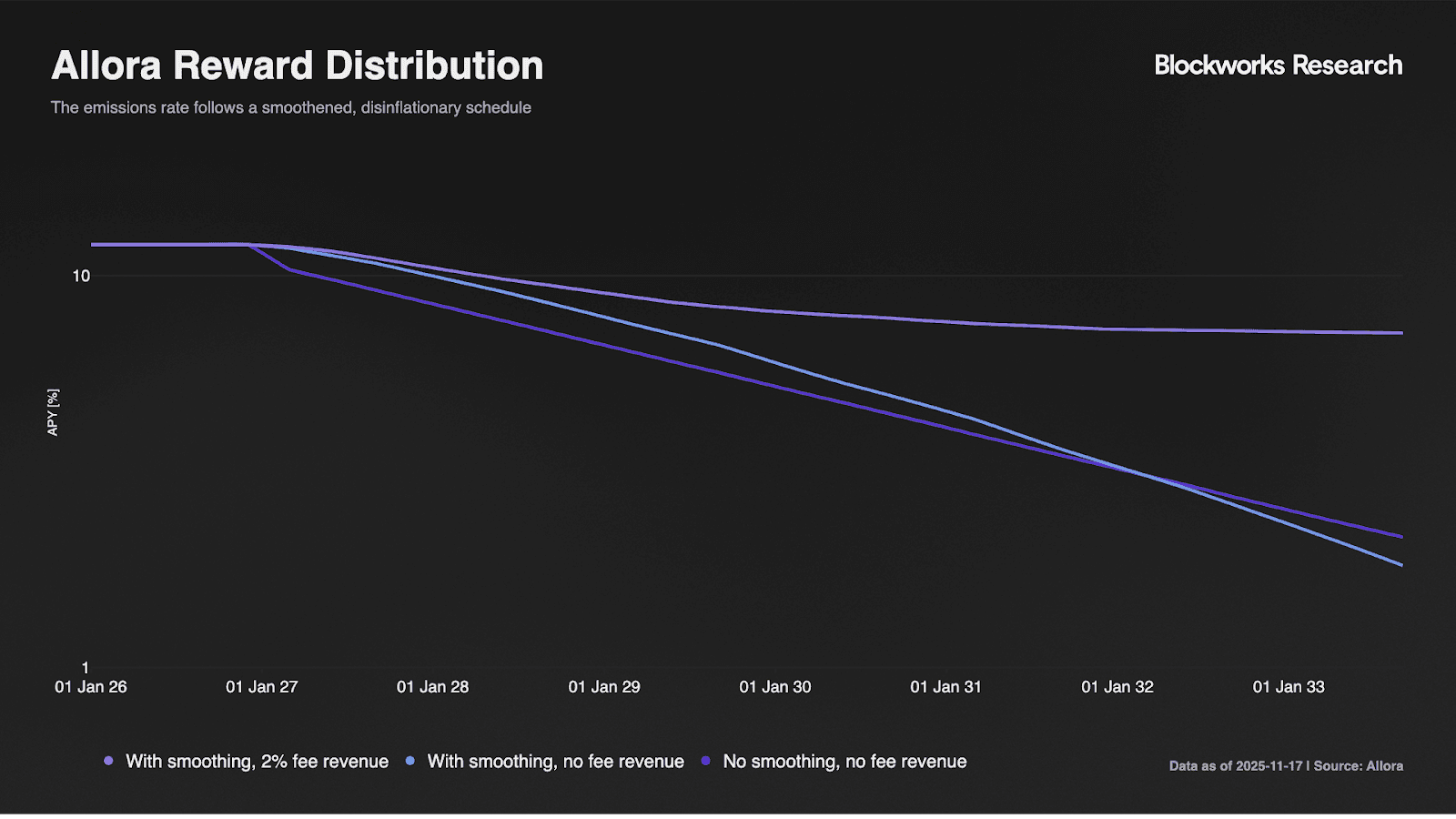
Illustration of a modeled APY (Source: Allora)
All staking rewards originate from monthly ALLO emissions designed to avoid APY crashes during unlock events, bootstrap early participation in new topics, and fund security across both blockchain and intelligence layers. This asymmetric allocation reflects the protocol's prioritization of intelligence production over pure blockchain security, acknowledging that Allora's core value proposition lies in coordinated AI inference rather than consensus alone.
Dual Staking Architecture
Allora's staking system operates across two distinct layers with different risk-reward profiles and reward mechanics that stem from their fundamentally different security functions.
Validators secure the Allora blockchain infrastructure and earn from the fixed 25% validator emissions pool, distributed proportionally based on stake weight. This structure produces predictable yields similar to traditional PoS networks, with base APY around 10% reaching up to 50% with Prime staking boosts. Validator rewards remain independent of AI inference activity or topic performance, creating stable, infrastructure-layer returns with low variance.
Reputers evaluate worker inference accuracy within specific topics, securing the mechanism that determines which AI models produce correct outputs. Unlike validators, reputer rewards are dynamic and topic-specific, drawn from the 75% topic emissions pool. Topic-level emission allocation depends on the total reputer stake and recent fee revenue. Then, the reward distribution among participant classes within a topic (inferers, forecasters, reuters) depends on the entropy of their individual rewards.
Within each topic, reputer rewards follow a consensus-based mechanism. Reputers maximize earnings when their accuracy assessments align with network consensus, they attract delegated stake from token holders, their chosen topics maintain high activity levels, competition from other reputers remains limited, and their evaluations consistently match reputer consensus. Conversely, rewards decrease when reputers disagree with network consensus, operate in inactive topics, or face dilution from numerous competing reputers. Reputer delegation is currently showing up to ~300% in protocol-generated rewards. As more stake flows into the intelligence layer, these rewards will naturally converge toward validator-like levels.
This dual-layer staking architecture creates distinct participation opportunities with clear risk-return tradeoffs. Validators provide stable, infrastructure-layer returns comparable to established proof-of-stake networks, while reputers offer higher-risk, higher-reward exposure to AI inference quality and topic-specific performance. The yield differential reflects fundamentally different security functions: validators secure transaction ordering and finality through stake weight alone, while reputers secure intelligence quality through accuracy assessment that requires continuous evaluation of model outputs against ground truth. As the network matures and reputer supply increases, the yield spread between validators and reputers should compress, though reputer returns will likely maintain a premium reflecting the additional work and accuracy risk involved in performance evaluation.
Network Performance and Case Studies
Beyond architecture and incentives, Allora now has a growing body of empirical evidence that its coordination mechanisms produce measurable signal in live markets and real applications.
During testnet, Allora ran a 5‑minute BTC log‑return prediction topic that generated roughly 10,000 predictions over about a month. The retrospective performance report shows a statistically significant Pearson correlation of 0.09 between predicted and realized log‑returns, and directional accuracy of 53.22%, meaning the network was on the right side of the trade slightly more than half the time in a regime where “fair” accuracy is 50%. Other topics achieved comparable or better directional accuracies across other assets and horizons: ~51.8% for 5‑minute ETH, ~51.7% for 5‑minute SOL, ~58.8% for 1‑day BTC, and ~56.5% for 1‑day ETH, all with tight confidence intervals that remain several standard errors above 50%.
The report also shows that workers with chronically poor performance are assigned systematically higher forecasted loss and therefore receive negligible weight in the synthesized inference, while the regression lines for individual workers exhibit positive slopes, indicating a positive correlation between forecasted and realized losses. This is the core of Allora’s “context awareness”: the synthesis layer re‑weights models not just on trailing averages, but on which ones are expected to work right now. On the network side, the Allora Studio explorer now shows a variety of active topics, worker nodes, and reputers participating in validation and staking, such as covering price predictions for BTC, ETH, and SOL across various time intervals. Allora’s predictive feeds are embedded in a growing number of production integrations where performance can be measured against concrete baselines.
A detailed case study with Steer Protocol compared a classic spot‑price‑triggered Uniswap‑style rebalance strategy to an “Allora Strategy” that used 5‑minute and 8‑hour ETH price topics to move liquidity bands pre‑emptively across major ETH/USDC pools on Uniswap v3 (Arbitrum), DragonSwap (Sei), Camelot (Arbitrum), QuickSwap v3 (Polygon) and SushiSwap (Base). Over the January 10–28 test window, the Allora‑driven strategy ended with +0.75% average performance versus –0.08% for the classic approach, achieved a higher peak performance (4.77% vs. 1.86%), and exhibited smaller worst‑day drawdowns. Edge‑factor analysis showed the Allora strategy’s positioning advantage frequently in the 0–5% range and spiking toward ~10% during sharp moves, consistent with the thesis that forecasting reduces time spent out of range and mitigates loss‑versus‑rebalancing.
A separate “Big Tony” case study with Cod3x provides an agent‑level view. After integrating Allora’s BTC price predictions, Cod3x’s flagship trading agent executed 241 BTC trades between December 2024 and the end of January 2025, averaging 2.54% profit per trade. Over the same window, simply holding BTC would have yielded ~9.2%, whereas Big Tony’s strategy realized ~11.2%, a 21.7% uplift versus buy‑and‑hold while trading only ~40% of the portfolio and capping per‑asset exposure at 10%. Moving from fixed‑interval to event‑driven inference calls, again powered by Allora, cut the agent’s compute costs by over 70%.
Partnerships and Integrations
A key indicator of Allora's strategic execution is its rapidly expanding and strategically curated ecosystem of partners. The partnerships are heavily concentrated in the Infrastructure and DeFi sectors, signaling a clear go-to-market strategy focused on becoming the intelligence backbone for AI agents and advanced financial applications.
Coinbase: Integration with AgentKit, a toolkit for creating autonomous blockchain agents. Positions Allora as a core intelligence provider for one of the industry's leading agent development frameworks. The partnership enables AgentKit-powered agents to query Allora topics for real-time predictions, such as short-term price movements or volatility forecasts, transforming agents from static rule-based automation into adaptive systems that execute financial operations based on dynamic market intelligence.
Alibaba Cloud: This collaboration will add cloud computing and infrastructure support for the network through Cloudician, an Alibaba Cloud ecological partner joining as a validator. Cloudician brings proven infrastructure expertise across major blockchain ecosystems including 0G, Conflux, Fetch.ai, and Oasis Network, strengthening Allora's consensus layer and network decentralization. The partnership validates Allora's technology for enterprise-grade applications and provides a pathway to institutional adoption through Alibaba Cloud's global infrastructure network and enterprise relationships.
Story Protocol: This integration provides intelligent IP management and price feeds for tokenized intellectual property. Allora's AI models analyze market trends and user engagement to deliver valuation insights for creative works, while providing real-time price feeds for long-tail, illiquid assets including NFTs, real-world assets, carbon credits, and tokenized IP rights. The network employs sophisticated upsampling techniques to generate accurate price discovery for historically challenging asset classes where traditional pricing mechanisms fail due to low liquidity or infrequent transactions.
Injective: The partnership enables developers building on Injective to create AI agents that execute complex financial operations (trading, portfolio management, capital allocation) through natural language commands powered by Allora's inference synthesis. Rather than relying on single static models, agents accessing Allora dynamically adapt strategies based on real-time market conditions, volatility forecasts, and emerging patterns across multiple specialized models.
Developer Tooling and Model Development Kit
To support this ecosystem, Allora provides a robust suite of developer tools designed to minimize friction and accelerate contribution:
Model Development Kit (MDK): An open-source, comprehensive Python framework that simplifies the entire lifecycle of building, training, and deploying time-series forecasting models (such as ARIMA, LSTM, LGBM, and XGBoost) as workers on the Allora Network.
Software Development Kits (SDKs) and APIs: Allora offers SDKs in Python and Typescript, alongside a high-level API, to enable developers to easily interact with the network, query topics, and integrate the network's synthesized inferences directly into their dapps and agent logic.
Forge Builder Kit: A series of educational notebooks and tools designed to guide developers through the process of building and deploying ML models for competitions and network participation.
Bittensor: Competitive Intelligence Marketplaces
Bittensor operates as a "marketplace of marketplaces," creating a permissionless network where independent intelligence markets (subnets) compete for network resources. Bittensor decouples the consensus layer from the intelligence layer: the Subtensor blockchain (a Polkadot-based L1) handles coordination, payments, and record-keeping, while offchain subnets define their own incentive mechanisms, tasks, and evaluation logic.
Architecture and Yuma Consensus
The network functions as a three-layer stack: the Subtensor PoS chain, the subnet application layer, and an EVM-compatible smart contract layer. This design allows validation logic to be written in any language (Rust, Python, C++) and executed offchain, pushing only the final weight vectors onchain for consensus.
The core coordination engine is Yuma Consensus, which translates validator assessments into economic rewards. Yuma employs stake-weighted clipping to prevent collusion and enforce honest evaluation. It calculates a consensus weight vector for miners based on validator input; any validator whose scores deviate significantly from the stake-weighted median is "clipped," effectively punishing divergent or malicious grading.
Rewards within a subnet follow a rigid, programmable split:
- 41% to Miners: For producing the digital commodity (intelligence).
- 41% to Validators: For accurately scoring miner output (typically passing ~82% of this yield to delegators).
- 18% to Subnet Owners: For managing the subnet infrastructure and incentive mechanism.
Dynamic TAO (dTAO) and Market-Driven Emissions
In February 2025, Bittensor activated Dynamic TAO (dTAO), restructuring how network inflation is allocated. Previously, a small set of root validators determined which subnets received emissions. dTAO replaces this with a market-driven allocation mechanism via subnet-specific Alpha tokens.
Each subnet now operates an onchain AMM pool, pairing TAO with its native Alpha token. Market participants stake TAO to purchase Alpha, and the relative price of a subnet’s Alpha token determines its share of global emissions. This shifts the network from a validator-curated model to a capital-weighted democracy, where the market explicitly prices the value of the intelligence produced by each subnet.
The base TAO token retains a Bitcoin-like issuance schedule capped at 21M with a halving event scheduled for December 2025, ensuring that while allocation is dynamic, total supply remains scarce.
Ecosystem: Financial Intelligence and Institutional Rails
Bittensor’s live demand has shifted from generic text generation to a set of financial and agent marketplaces. As of Q4 2025 the network hosts 128 active subnets, with a growing share of dTAO emissions and liquidity routing into finance-heavy markets and their Alpha tokens.
Precog (SN55, Coin Metrics): Precog is a high-frequency Bitcoin forecasting subnet built by Coin Metrics. Every 5 minutes, miners submit a 1‑hour‑ahead BTC/USD forecast using institutional-grade network and market data feeds. Validators aggregate these point and interval forecasts and reward miners whose signals most closely match realized prices. Coin Metrics’ performance studies on live Precog outputs show that even naive strategies that trade purely on Precog forecasts have repeatedly outperformed buy‑and‑hold BTC across multiple 14‑day windows, with an enhanced “variable size” strategy beating buy‑and‑hold in 12 of 18 samples and underperforming in only 2.
Proprietary Trading Network (SN8, Taoshi): SN8 is a decentralized prop trading network built by Taoshi that runs a fully simulated futures environment across FX, BTC, ETH, and indices. Miners run machine learning models that emit LONG / SHORT / FLAT signals into this environment; validators maintain portfolios, apply carry, spread, slippage, and fee models, and track PnL under strict risk constraints. The subnet hard‑codes institutional‑style risk controls: miners are eliminated if max drawdown exceeds 10%, if trade sequences are detected as plagiarized, or if they fail to outperform the 15th‑ranked miner during a 30‑day probation window. Emissions are allocated via a debt-based scoring system that scales rewards by risk‑adjusted performance and penalties. Economically, SN8 is now one of the largest financial markets on Bittensor: its SN8/TAO pool on the Subnet Tokens DEX holds roughly ~$38M in liquidity and the subnet currently receives ~3% of global dTAO emissions, giving successful miners a path to multi‑million‑dollar cumulative payouts while turning the subnet’s Alpha token into a levered bet on its trading edge.
Swap / TaoFi (SN10, DeFi Liquidity Layer): SN10 (“Swap”) is the DeFi plumbing layer for Bittensor. At the subnet level, miners are not model providers but liquidity providers: SN10 scores LP positions in the TAO/USDC Uniswap v3 pool on Bittensor EVM based on the trading fees they generated in the last 24 hours, and routes dTAO emissions to the most productive liquidity. TaoFi wraps this subnet logic into a user-facing bridge and DEX. Using Hyperlane messaging, TaoFi lets users bridge USDC from Ethereum and Base into Bittensor EVM, minting taoUSD and routing capital into TAO and subnet Alpha tokens. The initial bridge was launched with a $10M TVL cap, uses 1:1 backing with no protocol fee (gas only), and automatically airdrops small TAO balances to cover gas for larger deposits. On top of this, TaoFi exposes a Base-native interface where users can swap USDC, ETH, or USDT directly into native subnet tokens in a single transaction. Under the hood, swaps route through the TAO/USDC pool on Bittensor EVM, then into the desired subnet via canonical EVM precompiles, so users end up holding real Alpha tokens that immediately start earning emissions rather than wrapped IOUs.
Beyond Finance: Data and Agent Economies (Masa, SN42 & SN59)
Outside pure trading, Bittensor is being used as a coordination layer for autonomous agents and real‑time data. Masa operates two of the more important non‑financial subnets:
Gopher (SN42): Gopher is a real-time data layer that ingests and vectorizes data from X/Twitter, Discord, podcasts, gated media, and the open web, exposing it as a decentralized data feed for models and agents. The subnet uses dual‑token rewards, paying miners in both TAO and MASA, and already underpins data pipelines for a user base in the low‑seven figures.
Masa AI Agent Arena (SN59): A competitive “colosseum” for AI agents that is incubated by DCG’s Yuma Group. Agents compete for TAO emissions based on performance metrics such as contextual awareness, self‑improvement, and user engagement (mentions, impressions, replies, follower growth). Validators score agents in real time, creating a live benchmark for autonomous systems and turning Bittensor into a monetization and training venue for consumer AI agents.
These non‑financial subnets matter because they validate Bittensor’s core thesis: the same incentive machinery that prices trading signals and forecasts can also price data quality and agent behavior. In aggregate, the 128‑subnet metagraph now spans BTC forecasting, multi‑asset trading, cross-chain liquidity, social data, GPU markets, and autonomous agents.
Numerai: Stake-Weighted Ensemble Crowdsourcing
Numerai is a crowdsourced quantitative hedge fund that uses machine learning models submitted by a global community of data scientists to construct its trading strategies. It runs continuous online tournaments in which participants download an abstracted financial dataset, train models to predict a forward‑looking return target, and submit ranked predictions that are directly used by Numerai’s market‑neutral equity hedge fund. Rather than treating the competition as a toy benchmark, Numerai aggregates all submissions into a single ensemble signal that actually drives capital allocation in the underlying fund.
To make this feasible without leaking proprietary data or violating vendor licenses, Numerai distributes a heavily cleaned and obfuscated tabular dataset instead of raw price and fundamental time series. Each row corresponds to an unidentified stock at a particular weekly “era,” with columns of anonymous numerical features and a target measuring stock returns roughly 20 business days into the future. Obfuscation deliberately severs the mapping from rows to real‑world tickers and prevents participants from re‑using the data for their own trading, while still preserving the statistical structure needed to train predictive models.
Economic alignment is enforced through Numeraire (NMR), Numerai’s native ERC‑20 token. Once participants are confident in a model, they can optionally stake NMR on its live submissions; staking means locking tokens for the duration of the scoring window and allowing the protocol to either reward or burn them based on realized performance. After the roughly one‑month evaluation horizon associated with the 20‑day return target, models with positive scores receive additional NMR, whereas models with negative scores have a portion of their stake permanently destroyed. The staking contract caps per‑round gains and losses at ±5% of stake and scales rewards via a dynamic “payout factor” that shrinks as aggregate NMR at risk grows, keeping the system’s liabilities under control while preserving strong “skin in the game” incentives.
The core coordination primitive is the Stake‑Weighted Meta Model. Numerai computes a stake‑weighted average of all submitted prediction vectors to build the Stake‑Weighted Meta Model (SWMM); a model with more NMR staked on it receives a proportionally larger weight in this ensemble. This SWMM is then combined with hundreds of portfolio‑level risk constraints (country, sector, market and factor exposures, etc.) and fed into a convex portfolio optimizer that translates the ensemble signal into an implementable long–short equity portfolio. In other words, stake does not just affect payouts: it directly controls how much each model moves the hedge fund’s actual trading positions.
Numerai’s scoring system is designed to reward both accuracy and marginal information content relative to the existing ensemble. Submissions are scored on simple Pearson correlation with the target and on Meta Model Contribution. MMC is defined as the covariance between a model’s predictions and the target after those predictions have been neutralized to the current Meta Model, so it measures the contribution of the model’s orthogonal (non‑redundant) component. Intuitively, a model that is moderately accurate but highly differentiated can earn higher MMC than a very accurate model that simply replicates the existing ensemble. Payouts in the main tournament are currently a capped linear function of both CORR and MMC, with MMC given a higher weight (0.5×CORR + 2×MMC), explicitly favoring predictions that add unique value to the stake‑weighted meta‑signal.
Historically, Numerai also introduced True Contribution (TC), a portfolio‑level metric that measures how much a model’s predictions increase hedge‑fund returns at the margin. To compute TC, the SWMM is run through the portfolio optimizer, the hypothetical portfolio’s returns are observed, and the gradient of those returns with respect to each model’s stake is calculated; TC is the magnitude of this gradient and thus represents the model’s marginal impact on hedge‑fund performance. While TC is no longer the primary basis for tournament payouts, it illustrates Numerai’s broader design goal of tying rewards as directly as possible to real portfolio outcomes rather than just leaderboard metrics.
Because the meta‑model is stake‑weighted, Numerai’s coordination mechanism equates economic commitment with decision weight: an actor who controls a large NMR balance can, in principle, exert outsized influence on the ensemble and thus on the hedge fund’s trades. This risk of capital‑driven centralization is partly mitigated by the burn mechanics and payout caps. Large stakes on systematically poor models will be rapidly destroyed and cannot lose more than a fixed percentage each round, but the system still bakes a direct trade‑off between economic power and control. This makes Numerai a clear instance of stake‑weighted ensemble coordination: confidence is expressed not only by submitting predictions, but by risking capital behind them.
Beyond the original Numerai Tournament, the Numerai Signals product generalizes this stake‑weighted crowdsourcing paradigm to arbitrary stock‑level alpha signals. Instead of training on Numerai’s obfuscated dataset, Signals participants bring their own data — fundamental indicators, technical factors, or alternative data — and submit ranked predictions over a shared global stock universe, again with optional NMR staking and performance‑based rewards or burns. Signals submissions are evaluated on targets engineered to reflect stock‑specific, factor‑neutral returns, and successful staked signals are incorporated alongside Tournament models into the hedge fund’s portfolio construction pipeline.
Taken together, Numerai implements a stake‑weighted ensemble market in predictive models. Economic commitments (staked NMR) serve as a quantitative signal of confidence and govern how much influence each model has in the Meta Model, while MMC and related metrics ensure that rewards flow to models that contribute new information rather than merely echoing consensus. This synthesizes thousands of heterogeneous, self‑interested predictions into a single collective signal that the hedge fund can use to trade, exemplifying how “skin in the game” can be used to coordinate a distributed crowd of model builders into a coherent, high‑performing ensemble.
Complementary AI Infrastructure
Decentralized AI coordination extends beyond model aggregation networks like Allora, Bittensor, or Numerai. These protocols rely on a modular stack of complementary infrastructure to solve distinct coordination problems: agent discovery, compute verification, GPU supply pooling, and privacy-preserving execution.
Multi-Agent Coordination Protocols
While intelligence networks aggregate predictions, multi-agent protocols coordinate the economic relationships between the agents consuming those predictions.
Sentient (Ownership & Attribution): Sentient establishes an ownership layer for the AI economy, focusing on model attribution and revenue routing. Its "Melange" mechanism combines model fingerprinting with TEE-based execution to prove which model generated a specific output. This allows the protocol to route royalties to model owners via "The GRID" — a coordination fabric for agent components — without exposing underlying weights.
Olas (Autonomous Services): Olas (Autonolas) enables offchain autonomous services to operate as long-lived, onchain entities. Through its "Mech Marketplace," agents advertise capabilities and contract with one another for specialized tasks (e.g., data fetching or risk checks). Unlike static bots, Olas agents negotiate and settle payments for these services, effectively creating a composable economy of specialized labor.
Verifiable Machine-Learning Compute
Gensyn addresses the verification gap in decentralized model training. It connects "submitters" (model trainers) with "solvers" (compute providers) via a custom Ethereum rollup designed specifically for ML workloads. The protocol employs probabilistic verification and challenge-response schemes to cryptographically prove that a remote node correctly executed a training task on untrusted hardware. This distinguishes Gensyn from inference networks; it verifies the process of training, enabling a trustless market for model development.
Decentralized GPU Marketplaces
These protocols commoditize the hardware layer, converting idle GPU supply into a permissionless resource pool that undercuts centralized hyperscalers (AWS, GCP).
Akash Network: Operates as an open marketplace for GPU capacity, using a reverse-auction bidding model to match tenants with providers. This structure forces price discovery, often resulting in significant discounts relative to centralized clouds.
io.net: Aggregates underutilized hardware — ranging from enterprise data centers to crypto mining rigs — into virtualized clusters. By clustering disparate resources, io.net offers on-demand scaling for training and inference, claiming cost reductions of up to ~70% versus traditional providers.
Render Network: Originally a distributed rendering protocol for VFX, Render expanded into general-purpose AI compute via proposal RNP-019. This upgrade introduced dedicated nodes optimized for ML workloads, allowing the network to serve as a dual-purpose backbone for both creative and AI-driven jobs.
AI-Native Base Layers
NEAR Protocol positions itself as the execution environment for autonomous agents. The NEAR AI stack integrates NVIDIA GPU TEEs (Trusted Execution Environments) and Intel TDX to enable private, verifiable inference. This architecture allows agents to process sensitive data and manage keys within secure enclaves while anchoring state and settlement onchain. Frameworks like "Shade Agents" leverage this infrastructure to deploy cross-chain agents capable of executing programmable policies without exposing their internal logic or user inputs.
Risk Assessment
Technical: Multi-party coordination mechanisms introduce potential for coordination attacks, in the same vein as proof-of-work or proof-of-stake mechanisms being vulnerable to 51% attacks. This involves workers coordinating to submit low-quality inferences while forecasting high performance for each other. Early network stages with lower amounts of TVL are the most vulnerable to these types of attacks. With that said, any mature network with sufficient economic security should be resilient to this risk vector.
Allora goes a step further through novel mechanism design. The network downweights colluding reputers via their “listening coefficient” mechanism. Furthermore, if a majority colludes, the topic loses revenue, and thus rewards, in turn disincentivizing the attack entirely. Users should be aware of this risk vector specifically when interacting with networks without these types of safeguards, or ones that are backed by small amounts of capital.
Competition: Decentralized solutions naturally compete with leading Web2 tech companies that control vast amounts of resources. The limited pool of elite data scientists intensifies competition, where high-performing model developers can choose where to deploy their work, and networks must compete on economics, developer experience, and total addressable market to attract them.
Network effects create winner-take-most dynamics, meaning second-place protocols capture disproportionately less value than market leaders. New topics face a cold start problem that compounds these challenges. Topics generate no value until reaching a critical mass of quality workers, but workers lack incentive to join until topics generate meaningful fees. Breaking this cycle requires foundation subsidies or strategic partnerships that artificially bootstrap demand.
Regulatory: Classification ambiguity is the core issue. These networks sit at the intersection of data services, software platforms, and financial markets. Securities regulators like the SEC scrutinize native tokens, where commodities regulators like the CFTC examine prediction market functionality, and data protection authorities apply frameworks like GDPR. No clear precedent exists for how regulators will classify these hybrid systems.
Autonomous agent liability presents a novel legal frontier as well. When an AI agent powered by decentralized intelligence executes a trade causing material losses, determining legal responsibility among the agent operator, network developers, and anonymous model providers is exceptionally difficult. No established legal framework addresses liability distribution in these scenarios. Early litigation will set precedents that could fundamentally reshape how these networks operate, and unfavorable rulings could force architectural changes that undermine core value propositions.
Conclusion
Decentralized AI coordination directly targets a structural mismatch in Crypto via applications designed to minimize trust and single points of failure increasingly depend on centralized AI services that reintroduce both. By turning model outputs into networked markets for intelligence, these protocols offer a path to align the intelligence layer with the same principles that underpin decentralized infrastructure.
In the near term we expect to see multiple use-cases: risk management in DeFi, market forecasting, and agent-driven execution are all domains where marginal improvements in reliability and accuracy can translate into meaningful economic impact.
Within this landscape, Allora represents a differentiated attempt to move beyond static ensemble methods. Competing approaches like Bittensor’s subnet marketplaces and Numerai’s stake-weighted ensembles highlight that there is no consensus architecture for decentralized intelligence. Instead, the sector is experimenting with how to measure contribution, how to allocate rewards, and how to trade off decentralization, performance, and coordination overhead.
Given these networks are still at an early stage, investors and builders should focus less on headline valuations and more on concrete indicators of progress such as sustained usage in high-stakes applications, evidence of improved decision quality versus centralized baselines, and further integration into production systems. Ultimately, the sector’s long-term relevance will be determined not by narrative appeal, but by demonstrable, repeatable improvements to real-world decision quality and deep integration by AI agents.
—
This research report has been funded by Allora. By providing this disclosure, we aim to ensure that the research reported in this document is conducted with objectivity and transparency. Blockworks Research makes the following disclosures: 1) Research Funding: The research reported in this document has been funded by Allora. The sponsor may have input on the content of the report, but Blockworks Research maintains editorial control over the final report to retain data accuracy and objectivity. All published reports by Blockworks Research are reviewed by internal independent parties to prevent bias. 2) Researchers submit financial conflict of interest (FCOI) disclosures on a monthly basis that are reviewed by appropriate internal parties. Readers are advised to conduct their own independent research and seek the advice of a qualified financial advisor before making any investment decisions.