This research report has been funded by Chainlink Labs. By providing this disclosure, we aim to ensure that the research reported in this document is conducted with objectivity and transparency. Blockworks Research makes the following disclosures: 1) Research Funding: The research reported in this document has been funded by Chainlink Labs. The sponsor may have input on the content of the report, but Blockworks Research maintains editorial control over the final report to retain data accuracy and objectivity. All published reports by Blockworks Research are reviewed by internal independent parties to prevent bias. 2) Researchers submit financial conflict of interest (FCOI) disclosures on a monthly basis that are reviewed by appropriate internal parties. Readers are advised to conduct their own independent research and seek advice of qualified financial advisor before making investment decisions.

Chainlink: The Infrastructure Standard for Onchain Finance
Key Takeaways
- Tokenized financial markets are expected to grow from the ~$300B level now towards $16T by 2030.
- As tokenization matures from an experimental technology to a major strategic priority for financial institutions, it has given rise to a new technology category: onchain finance.
- Integrators across TradFi and DeFi require a comprehensive set of infrastructure standards across market data, interoperability, compliance, identity, privacy, orchestration, and compatibility with existing systems.
- Integrators overwhelmingly select for out-of-the-box, battle-tested, and trusted infrastructure, as opposed to building middleware solutions in-house or patchworking multiple providers.
- Chainlink has evolved into the only comprehensive platform of oracle services that provides the broad set of features required by DeFi and TradFi integrators, offering foundational infrastructure for a new wave of financial applications.
Introduction
The global financial system is undergoing a generational transformation. Current market infrastructure is characterized by siloed ledgers, latent settlement, and time-consuming reconciliation. Given the demands of an increasingly digitally-native economy, institutions are exploring new frameworks for issuing, settling, and servicing financial assets through tokenization.
By enabling real-time settlement, programmable compliance, streamlined reconciliation, and enhanced transparency, onchain systems can provide greater operational efficiency and broader market access. However, realizing these benefits at scale requires robust and reliable infrastructure and an orchestration layer that can service and satisfy a full array of requirements across compliance, privacy, interoperability, composability, security, data, and more.
This report explores how tokenization is evolving from experimental pilots into a strategic imperative for the world’s largest financial institutions, giving rise to a new technology category: onchain finance.
The Onchain Finance Megatrend
Tokenization has evolved from a niche experiment to a strategic priority for global financial institutions. Today’s tokenized asset market is composed of $300B in stablecoins, $17.4B in private credit, $8.2B in US government debt, $2.3B in commodities, and $1.4B in public equities. Estimates underscore the scale of this shift. A report by BCG and ADDX projects that up to $16T of real-world assets could be tokenized by 2030, spanning public equities, private markets, real estate, and debt instruments. Similarly, Citi forecasts $4-5T in tokenized digital securities and an additional $5T in tokenized trade finance volume over the same period. These projections reflect a growing consensus that tokenization will not remain peripheral, but become the default.

The drivers behind this momentum are pragmatic. Onchain systems offer improvements to operational efficiency, liquidity access, programmability, transparency, and auditability. Settlement cycles can be reduced from days to minutes, minimizing counterparty risk and reconciliation costs. Certain assets that were historically encumbered by high minimums or limited access can be fractionalized and distributed more broadly. Financial agreements, business logic, policy enforcement, settlement, asset servicing, and reconciliation can be codified into smart contracts.

These benefits are not just theoretical but are already being realized in production. JPMorgan’s internal study of their Kinexys platform showed a 56% reduction in operating costs after integrating tokenization for intraday financing operations. Their study concluded, “Digital financing delivered unprecedented efficiency gains for the financial institution and proved to be a game-changer for optimizing its financing operations.” Tokenizing regulated assets like bank and central bank deposits could enable instant, 24/7 settlements on shared ledgers, reducing reliance on intermediaries and cutting transaction costs. As major banks collaborate on these networks, Deloitte forecasts that by 2030, one in four high-value international payments will use tokenized platforms, with cost savings of over $50 billion through a projected 12.5% reduction in cross-border payment costs.
Larry Fink, CEO of BlackRock, which has issued over $2.8B of its BUIDL fund onchain, believes that “the next step going forward will be the tokenization of financial assets, and that means every stock, every bond… will be on one general ledger.”
McKinsey estimates that “an end-to-end tokenized bond life cycle could unlock improved operational efficiencies of at least 40 percent through data clarity, automation, embedded compliance logic (for example, transferability rules encoded at a token level), and streamlined processes (for example, asset servicing). Additionally, lower costs, faster issuance, or fractionalization can improve financing for smaller issuers by enabling ‘just-in-time’ financing (that is, optimizing borrowing costs by raising specific amounts at specific times) and broadening the investor base by tapping into global pools of capital.”
Institutional Challenges & Infrastructure Requirements
Despite its benefits, tokenization introduces a complex set of operational, regulatory, and technical challenges. Adequately meeting these challenges requires a comprehensive infrastructure stack that is purpose-built for the end-to-end lifecycle management of a spectrum of financial instruments.
Institutions must satisfy KYC, AML, and jurisdictional requirements without compromising the benefits of composability and traceability. While blockchains are open and public by design, financial regulations demand selective disclosure, identity verification, transaction privacy, and configurable access controls. Tokenized systems must embed privacy protection and compliance capabilities.
Increasingly, real-world assets (RWAs) and stablecoins are utilized across a broad set of distinct blockchains operating on different runtimes, each hosting unique end-applications for tokenized asset utilization. Institutions may operate across private and permissioned networks, public blockchains, and offchain systems, and require interoperability across all of these systems. For tokenized assets to move seamlessly across these domains, secure, compliant, private, and reliable cross-chain messaging is mandatory.
Tokenized assets require real-time access to offchain data to function correctly. This includes market prices, NAV, corporate actions, interest rates, economic indicators, and identity attestations. Without secure and reliable mechanisms to verify and deliver this data onchain, blockchain systems cannot ensure accurate valuation, proper execution, or adherence to regulatory requirements.
Institutions require deterministic and atomic settlement across a multichain or hybrid environment. Finality must be both technically sound and legally recognized. Moreover, the infrastructure must support complex workflows such as contingent execution, net settlement, asset delivery-vs-payment, and synchronization with current payment and messaging networks like Swift.
The infrastructure to service growth in onchain finance must satisfy all of these conditions simultaneously. Failure to meet one condition, be it compliance, data integrity, or cross-chain interoperability, can render a tokenized product unviable. As such, institutional participation in onchain finance hinges on comprehensive and integrated infrastructure that can support the full spectrum of technical and operational needs.
Chainlink: The Infrastructure Standard for Onchain Finance
As the financial world shifts toward onchain systems, the need for robust, secure, and reliable infrastructure is foundational. As users from both DeFi and TradFi build out these new applications, institutions require security, privacy, reliability, flexibility, and composability across a spectrum of both onchain and offchain systems to fully satisfy their intended use-cases. Chainlink is the only platform that delivers secure data feeds, privacy-preserving data management, cross-chain messaging, policy and compliance enforcement tools with a fully composable development and orchestration environment.
This report explores how the Chainlink platform and its core standards across data, interoperability, compliance, and privacy, provide reliable infrastructure for both DeFi and TradFi institutions to build a new generation of financial applications.
The Chainlink Platform
Chainlink has evolved from a leading data oracle provider into a comprehensive platform of oracle services. It is the only platform offering a complete collection of operating standards to service the full lifecycle of tokenized assets and onchain finance. Its infrastructure has expanded beyond purely data delivery to host a collection of composable standards that form the foundation of any onchain finance use case. Similar to the internet’s reliance on foundational protocols such as TCP/IP and HTTP, Chainlink provides composable primitives upon which complex and complete tokenized asset workflows can be built. What a virtual machine is to a blockchain, Chainlink Runtime Environment is to Chainlink’s oracle networks: a computing environment where oracle networks can be programmed to execute any workflow. Each standard is modular yet integrated, allowing developers and institutions to tailor infrastructure stacks that meet specific operational and regulatory requirements without introducing fragmentation or counterparty risk. These standards encompass data, interoperability, compliance, privacy, and orchestration.
The Chainlink Platform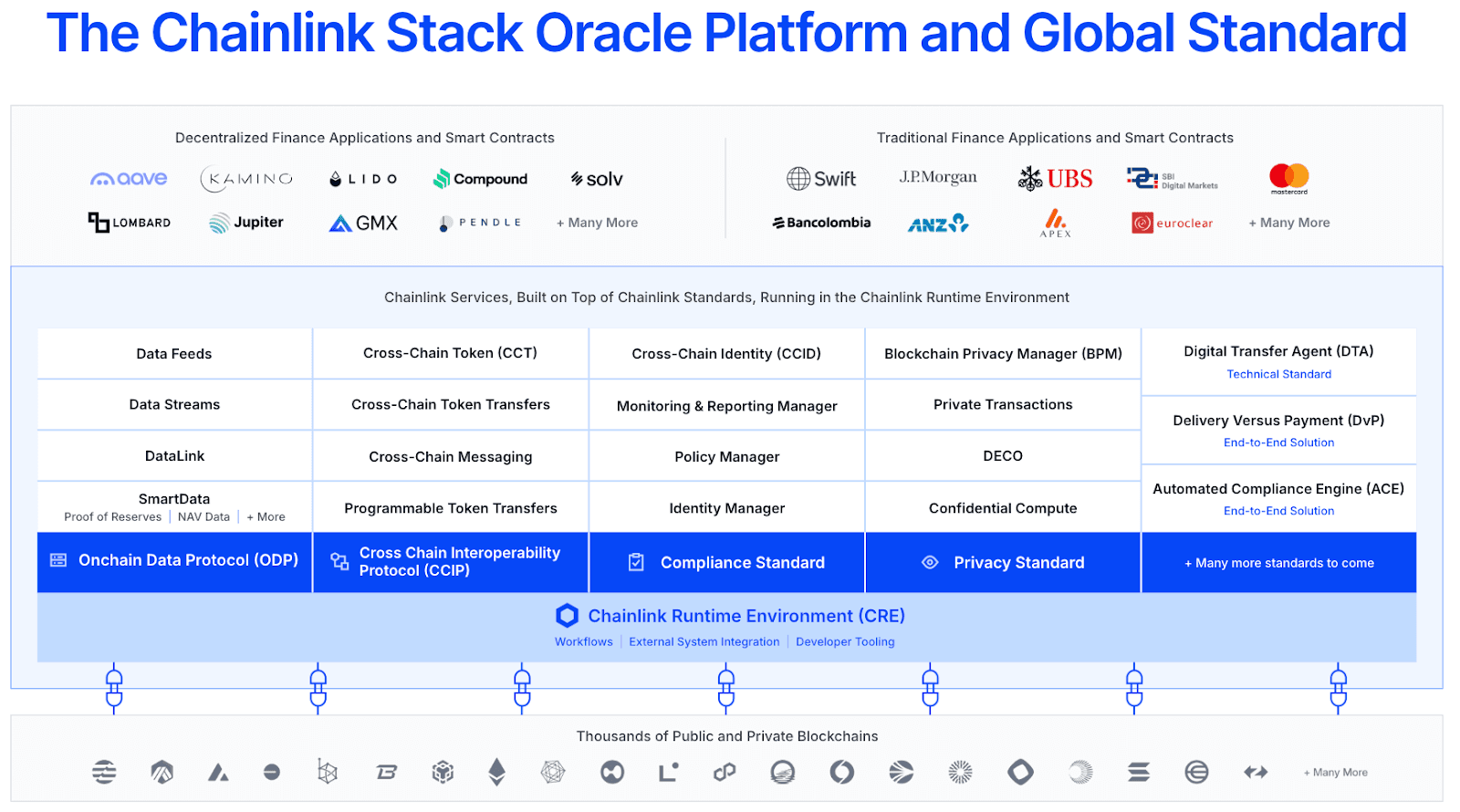
Source: Chainlink
For example, consider the lifecycle of a tokenized investment fund. The Chainlink data standard ensures the fund continuously receives trusted information (e.g., NAV calculations, market prices, corporate actions details, etc.) through secure decentralized oracle networks. The Chainlink interoperability standard (through CCIP) enables the fund’s tokens and associated data to traverse distinct blockchains and existing financial systems, ensuring connectivity across various environments. The compliance and privacy standards, implemented through the Automated Compliance Engine (Chainlink ACE) and Confidential Compute, guarantee that transactions adhere to jurisdictional requirements and confidentiality mandates. Together, these components allow tokenized assets to operate with the same regulatory integrity and operational assurance as traditional financial instruments, but with the added benefits of automation, composability, and real-time settlement.
Chainlink’s service offerings are underpinned by decentralized oracle networks (DONs), meaning multiple independent nodes fetch and deliver data to smart contracts, with the results aggregated onchain to produce a single, reliable source of truth. The network’s node operators include professional infrastructure teams and highly reputable entities, and the system has demonstrated an impeccable record of reliability. By design, no single point of failure or individual oracle can corrupt the output, and the use of LINK tokens for node operator fees and staking aligns incentives for honest performance.
Chainlink’s oracle networks are blockchain-agnostic, offering native support for 70+ public blockchains (including Ethereum, BNB Chain, Polygon, Avalanche, Arbitrum, Solana, and other layer-2 networks) as well as private/consortium chains. This broad support lets developers “integrate once, deploy everywhere” and has made Chainlink oracles the standard for onchain financial applications.
Chainlink currently dominates the DeFi oracle market. As of Q3 2025, Chainlink oracles secure roughly 68% of all value that depends on an oracle, and over 83% of the value on Ethereum specifically. More than 2,000 Chainlink Data Feeds are live, collectively securing over $95 billion in onchain value across 450+ applications. Chainlink oracles have delivered over 18 billion data points onchain and enabled more than $26 trillion in transaction value.

Data Standard
Onchain finance requires reliable data beyond just price, including NAV, corporate actions such as dividends and splits, fund metrics, and more. To meet these requirements, the Chainlink data standard provides a framework that enables developers to securely bring any external data onchain and use it as part of their blockchain transactions. This enables smart contracts to reference accurate, real-time information across virtually any market, ensuring that tokenized assets remain synchronized with their offchain equivalents.
The US Department of Commerce worked with Chainlink to bring official macroeconomic indicators (GDP, CPI, etc.) from the Bureau of Economic Analysis onchain via Chainlink Data Feeds. Intercontinental Exchange (ICE), which operates the NYSE and global market data services, is providing its high-quality FX and precious metals price feeds to smart contracts through Chainlink’s network.
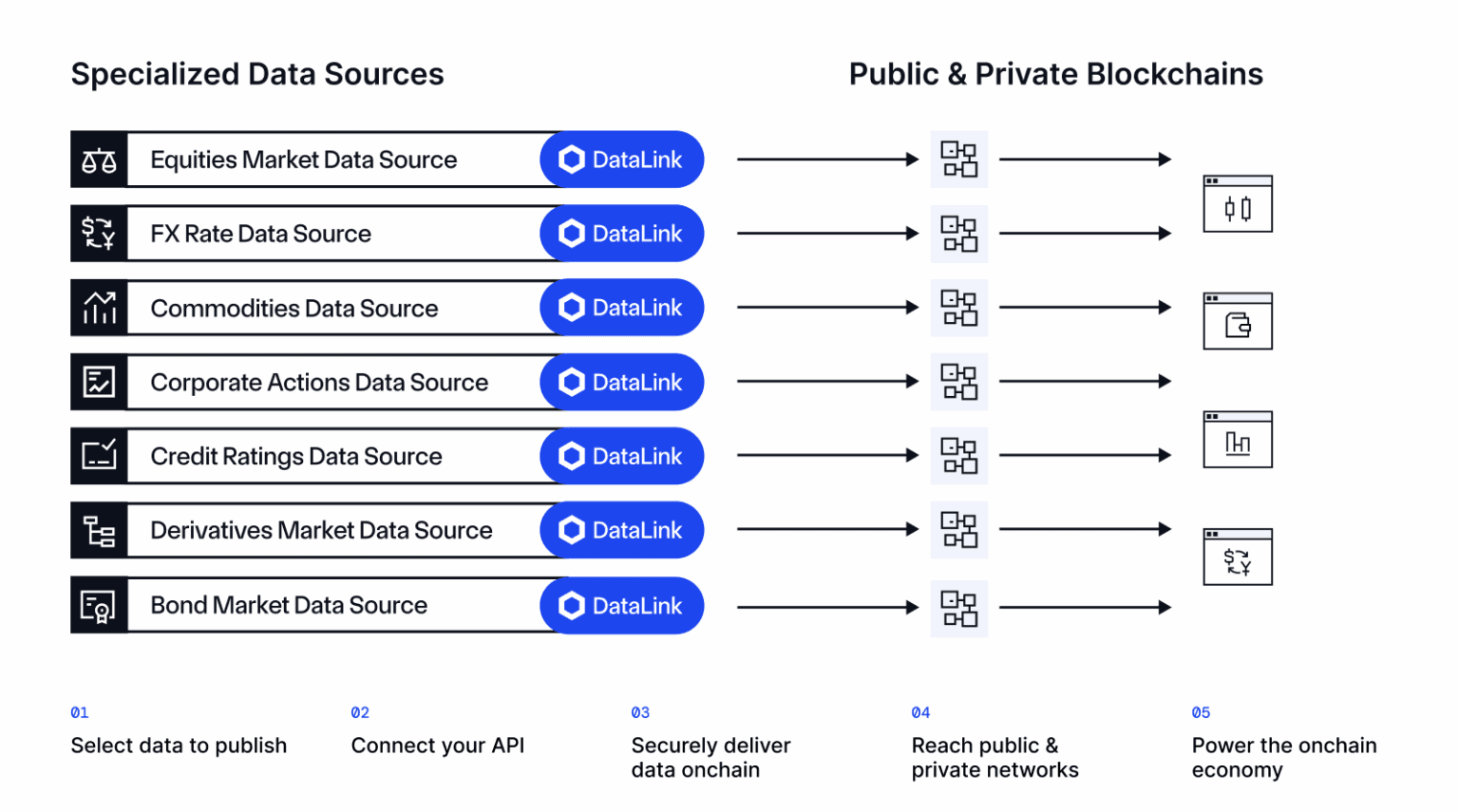
Traditional financial institutions can also leverage Chainlink’s oracle infrastructure to distribute their high-quality data onchain to be utilized within onchain applications. DataLink extends the Chainlink data standard into an institutional-grade data publishing service. It allows financial institutions, data vendors, and enterprises to distribute proprietary or bespoke datasets onto blockchain networks through Chainlink’s secure and reliable oracle infrastructure. This capability unlocks new use cases for onchain data types, including ESG metrics, credit risk models, custody, settlement, or derivatives pricing.
For example, S&P Global has announced that they are using DataLink to publish their Stablecoin Stability Assessments onchain. Additionally, Deutsche Börse is using DataLink to bring real-time data from Europe’s largest derivatives exchange onchain, including Deutsche Börse Group's Eurex, Xetra, 360T, and Tradegate trading venues covering equities, derivatives, and forex instruments. Similarly, FTSE Russell is using DataLink to publish their index data onchain. For institutions entering the onchain financial system, DataLink offers a bridge between traditional data distribution models and programmable, interoperable financial systems.
Source: Chainlink
S&P Dow Jones Indices and Dinari have partnered with Chainlink for the S&P Digital Markets 50 Index, the first tokenized benchmark combining US equities and digital assets. Chainlink will deliver real-time index values and token prices using its oracle infrastructure on the Avalanche blockchain. The integration includes Price Feeds, Proof of Reserve, NAVLink, and SmartAUM, with future plans to incorporate additional data feeds and compliance tools.
Similarly, WisdomTree, a global asset manager with over $130 billion in AUM, has partnered with Chainlink to bring real-time NAV data onchain for its CRDT tokenized private credit fund. The CRDT fund offers exposure to a diversified portfolio of liquid private credit assets, tracking the Gapstow Liquid Alternative Credit Index (GLACI). By integrating the Chainlink data standard on Ethereum, WisdomTree enables seamless, transparent, and auditable fund subscriptions and redemptions via its Prime and Connect platforms.
By enabling customizable and authenticated data publication, institutions can distribute, monetize, and manage their unique datasets onchain with cryptographic guarantees of accuracy and provenance. This offering extends Chainlink’s role not only as the dominant oracle provider but also as a comprehensive infrastructure layer for the data requirements of onchain finance.
Smart Value Recapture (SVR)
Lending and borrowing activities constitute a core onchain financial primitive, with now over $80B in capital supplied and over $30B in active loans. These applications require rigorous risk management to ensure efficient and timely liquidations and no occurrence of bad debt. Historically, these applications have offered liquidation bonuses of ~10% of the liquidation value as an incentive to keepers or MEV bots to call and execute a liquidation.
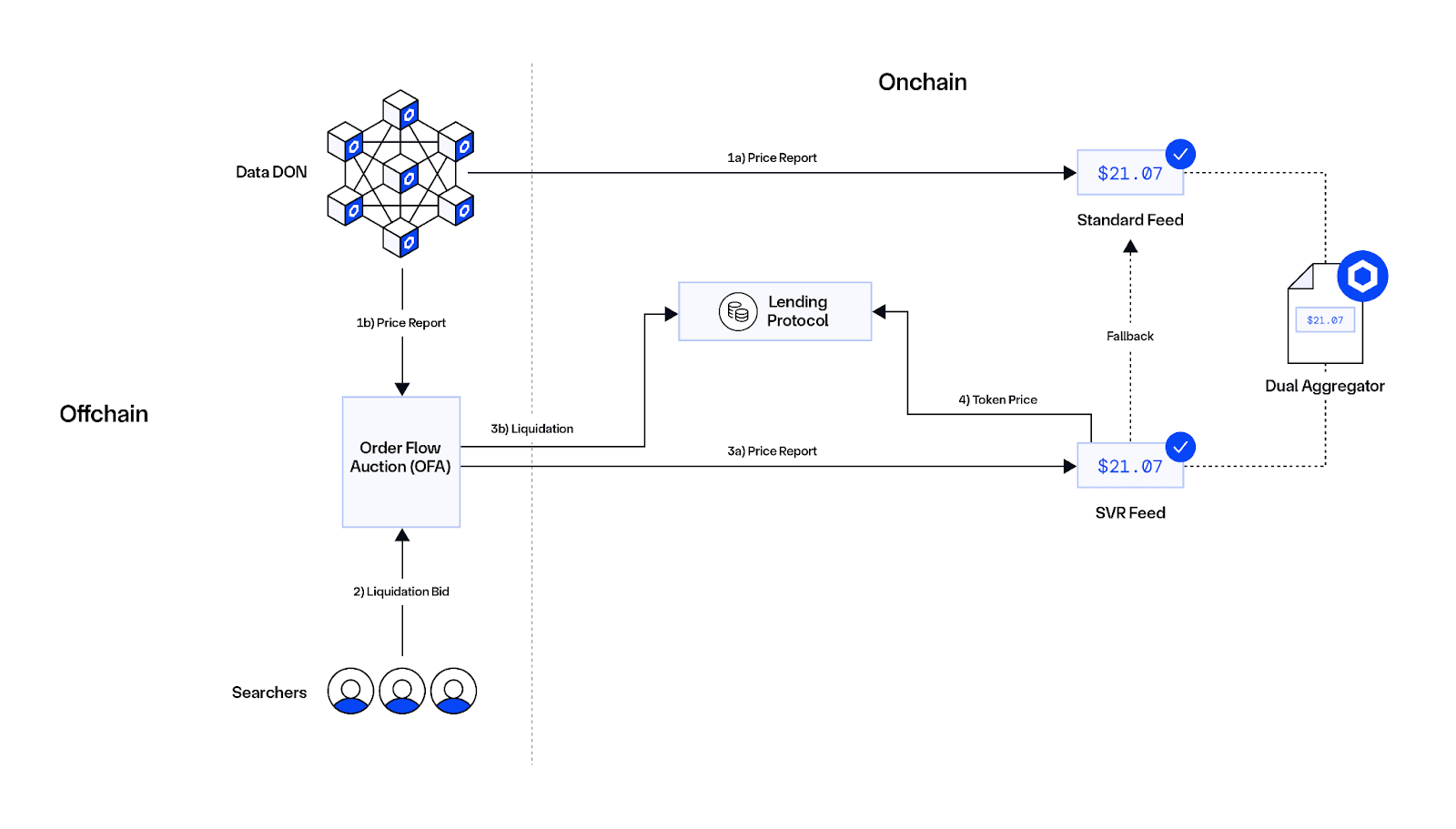
SVR is Chainlink’s offering for recapturing the non-toxic MEV that an application may generate and leak from liquidations. Rather than allowing block producers or external searchers to capture arbitrage profits from a liquidation, SVR introduces a competitive auction mechanism targeting specifically the value associated with an oracle price update (oracle extractable value, “OEV”). SVR is implemented in a way that is minimally intrusive for protocols already using Chainlink oracles, as it doesn’t require complex new contracts on the protocol side.
Source: Chainlink SVR
Under the hood, the initial version of SVR integrates with Flashbots’ MEV-Share system. Instead of publishing a new price directly onchain for anyone to act on and extract value, Chainlink nodes route the price update through a private mempool where a backrun liquidation transaction can be bundled with the oracle update. The “dual aggregator” architecture offers two paths for a liquidation: one path where the price update is delivered along with a liquidation transaction from an SVR auction, and another fallback path where, if the MEV capture doesn’t execute, the price feed reverts to a standard update. This ensures no loss of liveness, as the protocol will still get a price update even if the SVR auction fails. When an oracle update leads to a profitable liquidation, the profit is captured by the SVR system via a competitive auction among searchers, with the proceeds of the auction then split between the DeFi protocol and Chainlink.
SVR In Production
SVR is currently in its Phase 3 rollout on Aave’s Ethereum market, increasing coverage to ~75% of Aave’s Ethereum TVS, which represents ~95% of Aave’s OEV-relevant TVS. This market accounts for $42B in deposits and $17.2B in active loans, representing DeFi’s largest lending and borrowing venue with ~60% market share. As the SVR rollout has progressed from Phase 1 into Phase 3, the results show promising efficacy in recapturing value for the protocol. Across $265M in liquidations paying out $12.5M in liquidation bonuses, over $7M has been recaptured.
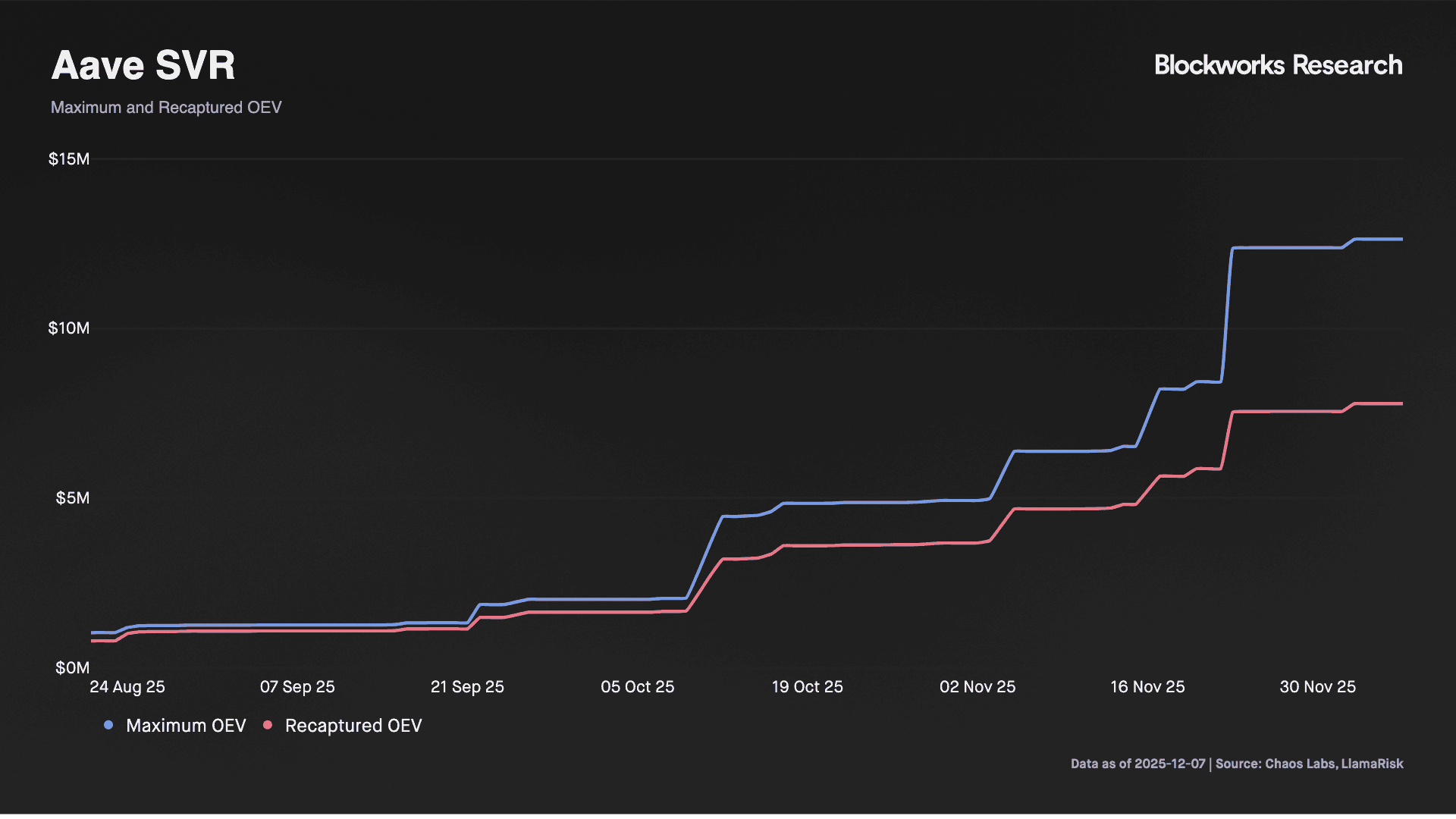
Currently, with Aave’s usage of SVR, the proceeds from recaptured OEV are split 65% going to Aave and 35% to Chainlink. As SVR coverage continues to grow across all markets for Aave and other lending protocols, SVR can present a meaningful line item for revenue growth for both Chainlink and the protocols that integrate.
Interoperability Standard
Chainlink’s Cross-Chain Interoperability Protocol (CCIP) enables secure cross-chain communication, allowing data, tokens, and tokens with instructions to move between different blockchain environments. As onchain finance expands across fragmented systems, including public blockchains and private ledgers, CCIP addresses a critical requirement by providing the ability for tokenized assets and the data that underpins them to move seamlessly across chains while preserving compliance logic, asset metadata, and operational continuity.
Architecturally, CCIP is built on Chainlink’s decentralized oracle network model—the same infrastructure that has enabled tens of trillions in transaction value. Every cross-chain transaction is handled by multiple DONs in parallel. In the current design, at least two primary oracle networks are involved, a Committing DON that initiates and commits a message on the source chain, and an Executing DON that receives and executes the message on the destination chain. In addition to the two DONs for multiple layers of security, CCIP boasts modular risk management features like Token Developer Attestation, which enables asset issuers to provide an additional layer of verification for the cross-chain transfers of their assets. CCIP is also equipped with compliance capabilities through the Chainlink Automated Compliance Engine (Chainlink ACE) as a part of the Chainlink platform. Chainlink ACE allows for checks before and during the transaction flow so that asset issuers can embed policy logic to meet their diverse set of requirements. 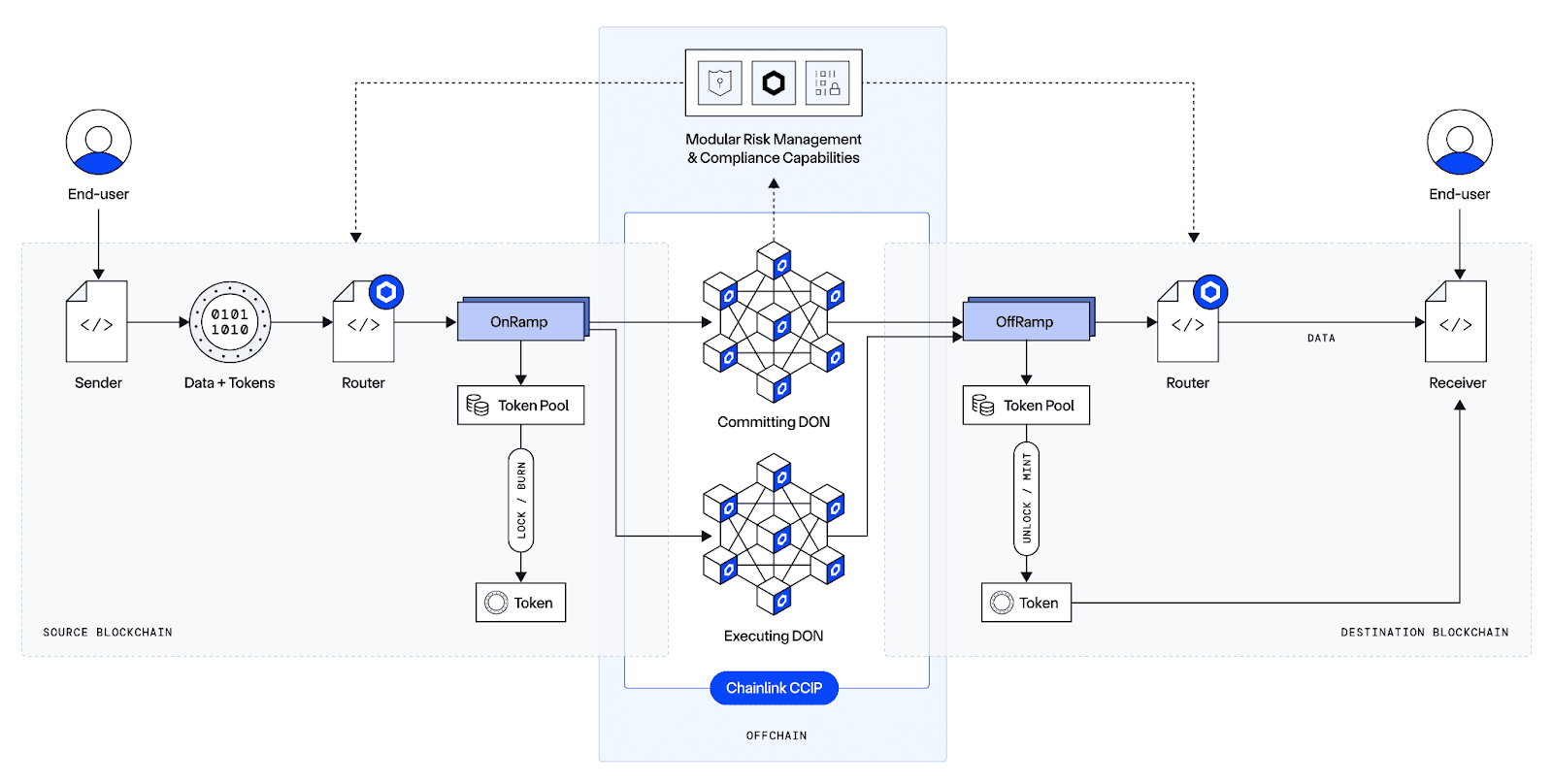
Source: Chainlink CCIP
CCIP is a generalized messaging and token transfer layer that developers can plug into their applications. A major use case is transferring value and data across chains, which is enabled by the Cross-Chain Token (CCT) Standard. CCIP provides audited token pool contracts and burn-and-mint, lock-and-mint, or lock-and-unlock mechanisms so that projects can securely transfer tokens from one chain to another without relying on centralized bridges, trusted intermediaries, external liquidity providers, or solvers. For example, a stablecoin or tokenized asset can be burned on Chain A and equivalently minted on Chain B, with CCIP handling the underlying communication and verification. This model, employed for Aave’s GHO stablecoin, Maple’s SyrupUSDC, and more, avoids the capital inefficiency and risk of maintaining large liquidity pools or capitalized solvers on each destination chain, while enabling zero-slippage transfers when using a burn-and-mint mechanism.
Beyond token transfers, CCIP supports arbitrary cross-chain function calls, enabling complex interactions. Smart contracts on different networks can invoke each other via CCIP, which opens the door to cross-chain decentralized exchanges, multichain lending markets, or interoperable NFTs. CCIP also supports the simultaneous transfer of tokens and data cross-chain through “programmable token transfers” that provide instructions to smart contracts on the destination on what to do with the tokens once received (e.g., when a token arrives at the destination chain, deposit into a lending market). Additionally, CCIP can carry instructions or tokenized assets between a permissioned bank ledger and a public blockchain, acting as a universal adapter. CCIP provides the highest level of security and universal connectivity. Ultimately, CCIP’s use cases span any scenario requiring the secure transfer of assets, information, or instructions across distinct onchain venues, allowing tokenized asset issuers to distribute their tokens across multiple environments while preserving the asset’s integrity.
Compliance Standard
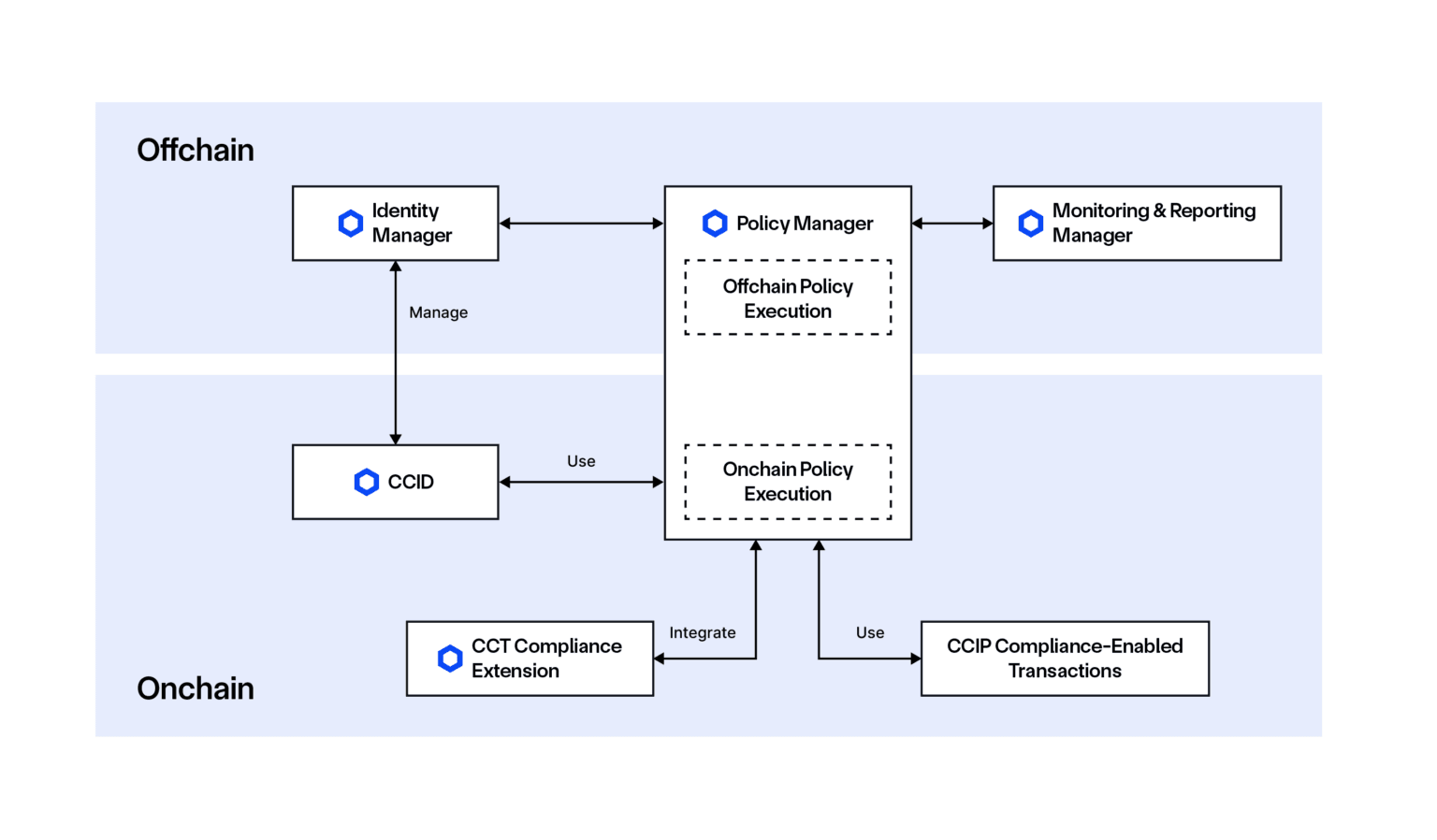
Chainlink’s Automated Compliance Engine (Chainlink ACE) is a modular compliance standard designed to enable institutions and developers to build, manage, and enforce compliance rules for digital assets and protocols onchain. The solution preserves privacy and offers functionality across public, private, and hybrid blockchain environments. The compliance framework is built around four key components:
The Cross-Chain Identity (CCID) establishes portable onchain personas by anchoring validated attestations (such as KYC/AML status, geographic location, or accreditation) to the blockchain, all while safeguarding private user data. Identity verification systems or trusted institutions can attest to credentials once, such that they become reusable and durable across platforms.
The Policy Manager delivers an adaptable engine for creating and executing rules, which sets and applies compliance measures (like spending caps, watchlist screenings, or participation prerequisites) for individual assets or entire protocols. It acts as a configurable rules engine that enables the definition, execution, and enforcement of compliance policies.
The Identity Manager acts as an intermediary layer, connecting real-world identity data (from sources like identity verification services or corporate identifiers) to their onchain representations (like the CCID standard), guaranteeing that these qualifications stay current and provable across multiple blockchains.
Finally, the Monitoring & Reporting Manager gives institutions tools for observing behavior (transactions, smart contract interactions), detecting anomalies or policy violations, issuing alerts, and creating audit logs needed for regulatory proofs, recordkeeping, and accounting.
Source: Chainlink ACE
The CCT Compliance Extension offers a standard for any token to inherit the compliance logic by integrating with CCID and a Policy Manager, enabling things like cross‑chain transfers under CCIP, enriched asset data, and enforcement of token‑level or protocol‑level compliance rules.
Privacy Standard
The Blockchain Privacy Manager component of the Chainlink privacy stack acts as a bridge, linking permissioned ledgers with the public Chainlink network, ensuring that only the data strictly required for transaction execution is exposed. This forms the basis of CCIP Private Transactions, an encryption/decryption system that enables secure and confidential exchange between private networks. It ensures transaction details like token amounts, involved parties, and specific terms remain encrypted and hidden from intermediaries, while allowing authorized parties to decrypt and audit them. This privacy suite is further complemented by DECO, a zkTLS oracle that verifies sensitive real-world data without ever disclosing the underlying information. As a whole, this technological stack directly confronts a major impediment to institutional uptake: the need to conduct transactions across different chains that are simultaneously confidential and verifiable.
Building on this foundation, Chainlink has introduced Confidential Compute, a privacy-preserving solution that unlocks private smart contracts on any blockchain. Encrypted inputs and outputs are processed securely offchain, and only a provable result is published onchain. This approach significantly expands the range of use cases that can be handled in a private yet secure manner, including the processing of encrypted inputs and outputs without ever exposing them to the public blockchain. Confidential Compute complements existing tools like DECO and CCIP Private Transactions, extending confidentiality to arbitrary computations and allowing smart contracts to access sensitive data and business logic while preserving their privacy. Use cases of Confidential Compute can extend privacy to transactions, asset tokenization, data distribution, cross-chain and onchain-offchain connectivity, identity, and compliance workflows. By unifying onchain verifiability with offchain confidentiality, Chainlink is providing essential infrastructure for both institutions and DeFi protocols entering the tokenized economy.
Chainlink Runtime Environment
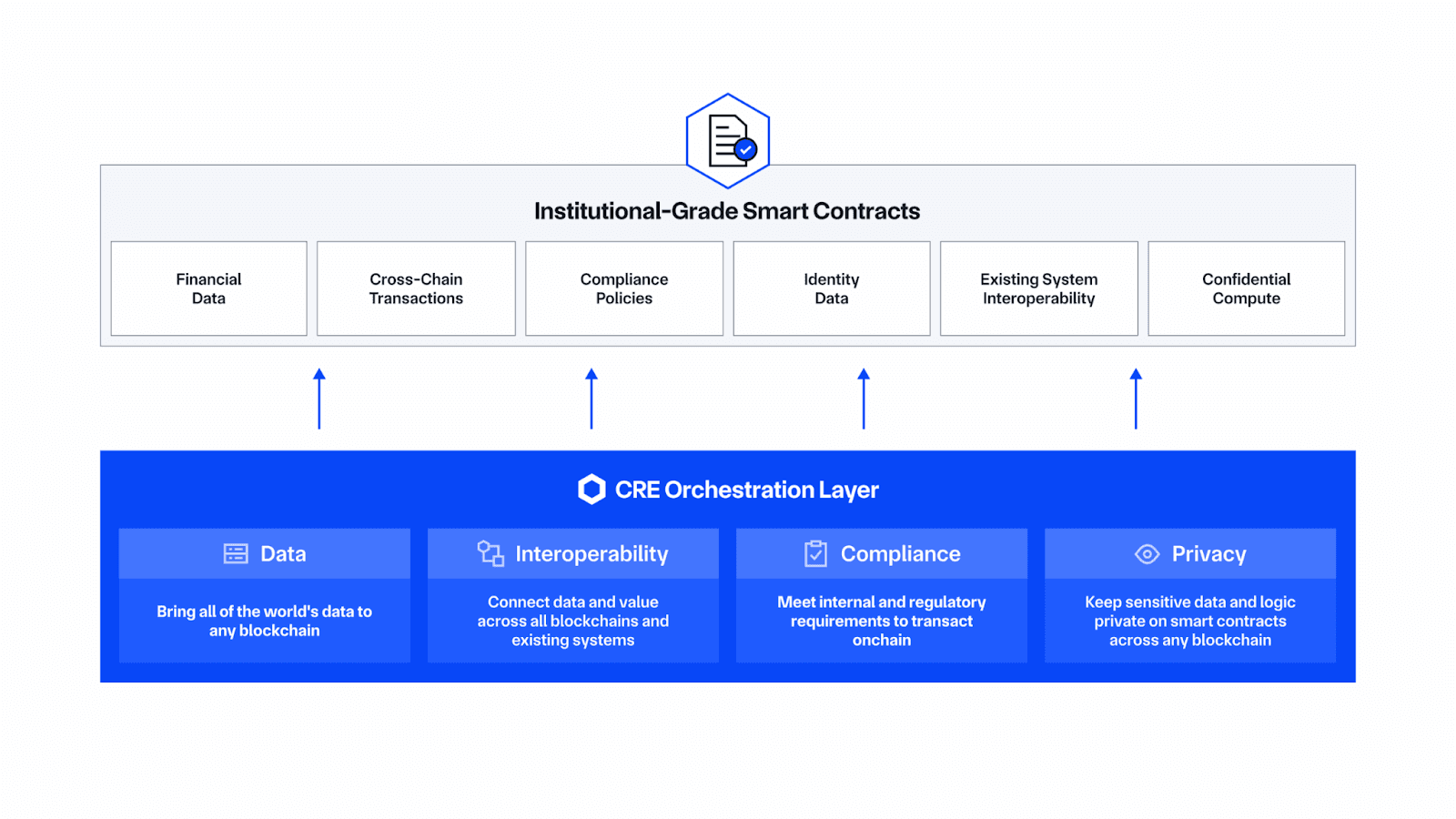
The Chainlink Runtime Environment (CRE) is an all-in-one orchestration layer that enables the creation of institutional-grade smart contracts for onchain finance. Developers can build smart contracts that interact with any blockchain, oracle network, financial infrastructure, and external API, all within one cohesive interface. CRE provides integrators with an abstraction layer that makes building upon the differences of underlying blockchains invisible to the developer, while composing institutional-grade smart contracts that employ any Chainlink standard or service.
Under the hood, CRE leverages specialized Chainlink DONs for distinct functions. For example, one set of nodes might handle an API call, another handles offchain computation, and another performs onchain transactions. Unlike the traditional Chainlink model where one might separately use Data Feeds, Automation, and Functions as different services, CRE allows the developer to compose all of these services programmatically into one workflow.
Source: Chainlink
Programs running in CRE can be triggered by external events like an API call, perform complex logic, consult external systems or offchain data sources, and subsequently produce verifiable outputs onchain. A key feature of CRE’s architecture is built-in trust-minimization and verification. When code executes in CRE, it does so across a decentralized oracle network and produces a cryptographic proof delivered onchain. This ensures that even though arbitrary code is running on CRE, the onchain contracts can trust the end results.
CRE also supports Confidential Compute and Chainlink ACE to satisfy privacy and compliance requirements. Sensitive data can be processed confidentially offchain, while still yielding a verifiable outcome onchain. This capability is critical for servicing institutional use cases that require data confidentiality and regulatory compliance.
Use Cases and Capabilities of CRE
The Chainlink Runtime Environment is accelerating the creation of cross-chain*, *cross-system institutional-grade smart contracts that would otherwise require orchestrating moving parts across distinct development environments. Developers access tools that cut build time from months or weeks to days or hours, allowing them to write their logic in one place instead of integrating multiple services.
CRE is particularly powerful for workflows that involve a combination of offchain inputs and onchain actions. For example, consider a tokenized asset settlement scenario: using CRE, a developer can build a workflow that listens for a security token trade on a blockchain, triggers an offchain compliance check such as querying a TradFi database or sanction list, then subsequently coordinates a delivery-versus-payment (DvP) transaction, moving the token on one chain while simultaneously instructing a payment on a bank network or another chain. All of this can be configured as a single CRE workflow, rather than handled via multiple bespoke integrations.
CRE explicitly enables new use cases for financial services and RWA tokenization. By connecting to any API or existing financial system, CRE can, for example, integrate directly with banking APIs, market data feeds, or compliance services. Triggers can include events from both onchain and offchain sources. This allows CRE to react to offchain events and execute an onchain transaction accordingly, or vice versa. Customizable capabilities allow developers to incorporate functions like consensus to validate data with multiple nodes, threshold signatures, or custom cryptography as needed, all operated by Chainlink nodes, eliminating the need for an integrator to run their own backend infrastructure.
Adoption and Integrations
CRE was unveiled in late 2024, offering an early access program. CRE was opened up to the public on Nov. 4, 2025, transitioning to a fully available smart contract orchestration layer. JPMorgan’s Onyx division, focused on institutional blockchain services, and Ondo Finance created a solution for cross-chain DvP settlement of tokenized US Treasury bonds using Chainlink infrastructure. In this solution powered by CRE, a tokenized bond on one network was exchanged atomically for stablecoins on another network.
Chainlink, in collaboration with UBS, used CRE to enable a landmark technical solution where financial institutions can trigger onchain tokenized fund workflows directly from their existing systems using Swift via ISO 20022 messages. CRE interprets Swift messages and subsequently invokes smart contract actions, allowing institutions to maintain their existing infrastructure and established operations while directly interacting with tokenized assets. With CRE, offchain messages from Swift can invoke onchain actions. The solution highlights a credible way for bridging current financial systems, such as Swift, with blockchain applications, offering a practical foundation for new applications composable across DeFi and TradFi systems.
UBS also completed the first live, end-to-end tokenized fund workflow using the Chainlink Digital Transfer Agent (DTA) technical standard. The transaction was executed through UBS Tokenize in collaboration with DigiFT, demonstrating the onchain automated subscription and redemption of a tokenized fund. The DTA standard integrates several Chainlink standards, including the CRE, CCIP, Chainlink ACE, and NAVLink. These tools enable secure orchestration, cross-chain functionality, compliance automation, and accurate pricing for institutional-grade financial systems.
For developer adoption, early feedback suggests CRE significantly reduces the complexity of building applications that require offchain integration. While full production deployments of CRE are just beginning, its feature design offers a new generation of sophisticated institutional-grade smart contracts at the convergence of DeFi and TradFi. CRE offers an orchestration layer to bring forward an entirely new generation of onchain finance, where financial applications are composable and interoperable across offchain and onchain systems.
Chainlink Economics & Network Security
The LINK token underpins the incentive mechanisms to operate Chainlink’s Decentralized Oracle Networks (DONs). Customers of Chainlink’s services pay node operators in LINK for their services performed. Users can also pay for Chainlink services in their preferred form of payment, in both onchain and offchain formats (e.g., stablecoins, gas tokens, fiat currency), which is programmatically converted to LINK via Payment Abstraction using a combination of Chainlink services and a decentralized exchange. Additionally, LINK is staked by node operators and other ecosystem participants as collateral to guarantee a quality of service, and nodes risk losing their stake through slashing if they provide incorrect data or act maliciously. Currently, ~$730M in LINK is staked.
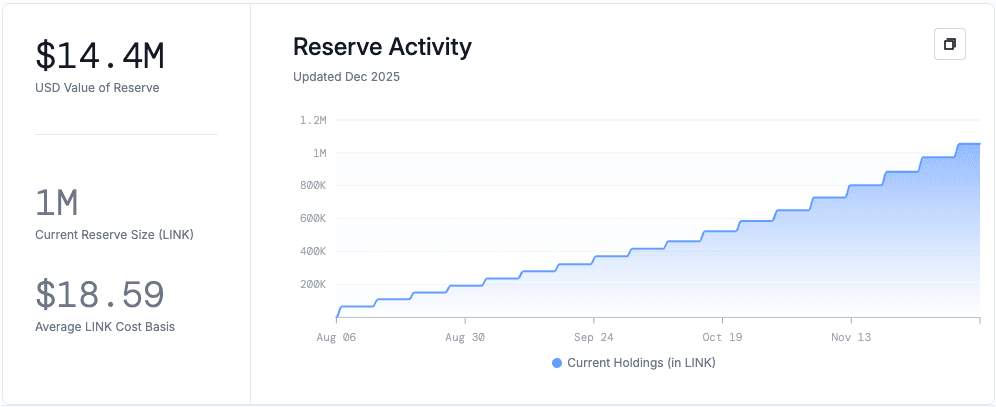
The Chainlink Reserve was introduced at the start of August as a mechanism to support the economic sustainability of the Chainlink Network. Using proceeds from both offchain revenue (large enterprise contracts and new chain integrations) and onchain service usage, revenue is converted to programmatically acquire LINK via Chainlink’s Payment Abstraction infrastructure, with LINK subsequently maintained in the reserve. As of its recent launch, the reserve has already accumulated over 1M LINK ($14.4M). Withdrawals from the reserve are not expected for several years, as the intent is for accumulation rather than short‐term distribution.
Source: Chainlink
At the current rate, ~$1.1M LINK is being accumulated each week, translating to $57.2M in Reserve inflows, annualized. With growing enterprise adoption across the Chainlink product suite, increasing DeFi TVS coverage with SVR, continued chain integrations, and a new wave of financial applications built on CRE, the Chainlink Reserve now offers a funnel to direct product monetization into a strategic onchain reserve.
Conclusion
As global financial institutions prioritize the adoption of blockchain rails to improve financial services and products, Chainlink’s infrastructure will continue to play a critical role in underpinning the growth of onchain finance.
Meaningful growth in onchain financial markets necessitates infrastructure that satisfies an extensive set of operational, regulatory, and technical requirements. Chainlink’s product offerings have evolved into the only platform offering a comprehensive set of solutions to meet the broad set of feature requirements necessary for institutional adoption of onchain finance. This infrastructure stack enables a new wave of onchain-native applications that are compliant, secure, and enterprise-ready. These capabilities are increasingly relevant as institutions seek to integrate existing systems with blockchain-native applications, and integrators will select for single vendors that meet all of their use cases, rather than patching together disparate vendors that can't.
As the onchain finance megatrend accelerates, this infrastructure is well-positioned to serve as the connectivity layer of this new financial system. Its ability to abstract complexity, enforce compliance, enable reliable cross-chain execution, and much more makes it foundational for institutions seeking to scale their blockchain use cases.
This research report has been funded by Chainlink Labs. By providing this disclosure, we aim to ensure that the research reported in this document is conducted with objectivity and transparency. Blockworks Research makes the following disclosures: 1) Research Funding: The research reported in this document has been funded by Chainlink Labs. The sponsor may have input on the content of the report, but Blockworks Research maintains editorial control over the final report to retain data accuracy and objectivity. All published reports by Blockworks Research are reviewed by internal independent parties to prevent bias. 2) Researchers submit financial conflict of interest (FCOI) disclosures on a monthly basis that are reviewed by appropriate internal parties. Readers are advised to conduct their own independent research and seek the advice of a qualified financial advisor before making any investment decisions.